

The Technological Revolution in Modern Minimally Invasive Spine Surgery: How 3D Computer Navigation Achieves "Smaller Incision, Less Pain, Faster Recovery"
Navigating Your Options with Precision
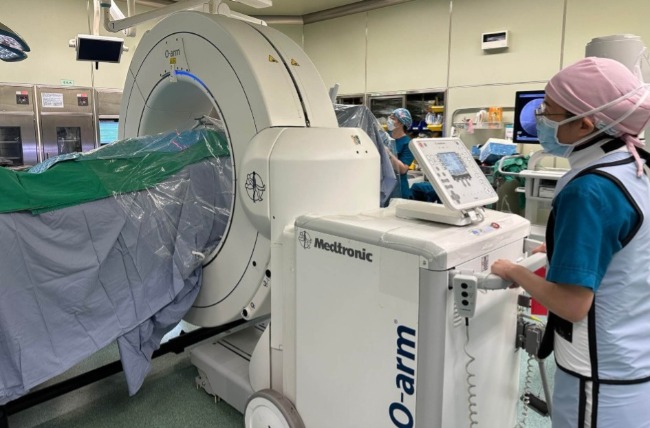
Spine surgery has now entered the era of "precision navigation." The Dr. Chien-Chun Chang Minimally Invasive Spine & Joint Team utilizes intraoperative real-time 3D computer navigation (O-arm) combined with minimally invasive techniques. This approach pioneers a safer, smaller-incision, and faster-recovery treatment pathway for elderly patients and those with complex conditions.
Who is Particularly Suited for "Navigated Minimally Invasive" Surgery?
This technology is not only applicable to common issues like herniated discs, spondylolisthesis, and stenosis but is also a key solution for the following groups:
-
Elderly Patients or Those with Comorbid Chronic Diseases:
Precision navigation significantly reduces tissue damage and bleeding, lowering surgical stress. The minimally invasive incision lessens pain, allowing patients to get out of bed earlier, helping to avoid complications associated with prolonged bed rest. -
Patients Requiring "Revision Surgery" or "Complex Correction":
For cases where previous surgery was ineffective, or for conditions like scoliosis or kyphotic deformities, 3D navigation acts like a surgical GPS map. It allows surgeons to accurately navigate through dense scar tissue or deformed anatomy, safely avoiding nerves during high-difficulty procedures.
Why is "Navigation" the Key to Safety and Precision?
Traditional surgery relies heavily on the surgeon's experience and 2D imaging, akin to navigating with an old map. Our 3D computer navigation system provides real-time, intraoperative imaging guidance.
1.Preoperative Precision Planning:
Surgical pathways are meticulously planned based on your preoperative MRI and CT scans.
2.Intraoperative Real-Time Navigation:
The O-arm device performs 3D scans, and the screen instantly displays the relative positions of implants and nerves, controlling placement error to <0.1 cm.
3.Minimally Invasive Technique:
Guided by navigation, implants are placed through a small incision of about 2-3 cm, maximizing the preservation of muscles and ligaments.
Diverse Minimally Invasive Solutions Under Precision Navigation: From Common to Complex Revision Cases
Building on the foundation of 3D computer navigation, we can select the most appropriate minimally invasive technique based on your diagnosis, proving our expertise not only in common conditions but also as specialists in complex "revision surgery."
The following outlines the signature spine procedures offered by our Minimally Invasive Spine & Joint Team:
-
Computer-Navigated Minimally Invasive Transforaminal Lumbar Interbody Fusion (MIS-TLIF)
For: Lumbar spondylolisthesis, instability, severe spinal stenosis.
Assisted by navigation, pedicle screws and interbody cages are implanted through a tiny incision to achieve permanent stability. This approach significantly preserves muscles and soft tissues compared to traditional fusion.
-
Computer-Navigated Oblique Lumbar Interbody Fusion (OLIF)
For: Patients requiring anterior fusion or wishing to completely avoid back muscle damage.
A minimally invasive approach from the side of the abdomen completely avoids back muscles and nerves. A larger cage is implanted to restore disc height, offering superior stabilization.
-
Minimally Invasive Approach to Complex Spine Revision Surgery
The success of revision surgery hinges foremost on "accurate diagnosis" — precisely identifying the pain source, whether it's hardware loosening, adjacent segment degeneration, or other issues. With extensive experience, Dr. Chien-Chun Chang's team provides precise diagnostic interpretation. Once confirmed, the aforementioned navigated techniques (MIS-TLIF, OLIF, or endoscopy) can be employed to operate safely within chaotic scar tissue. This "minimizes" traditionally large-open revision surgeries, achieving the goal of "small incision, fast recovery" even for second surgeries.
-
Computer-Navigated Scoliosis & Deformity Correction Surgery
For: Scoliosis, kyphotic deformities.
Intraoperative real-time 3D imaging allows the surgeon to accurately place multiple pedicle screws dynamically, achieving a high correction rate while minimizing neurological risks.
Our Commitment: Safety Through Technology and Experience
The success of computer-navigated minimally invasive surgery is built upon investment in cutting-edge equipment and an experienced team. We have introduced the advanced O-arm 3D computer navigation system to elevate patient surgical outcomes.
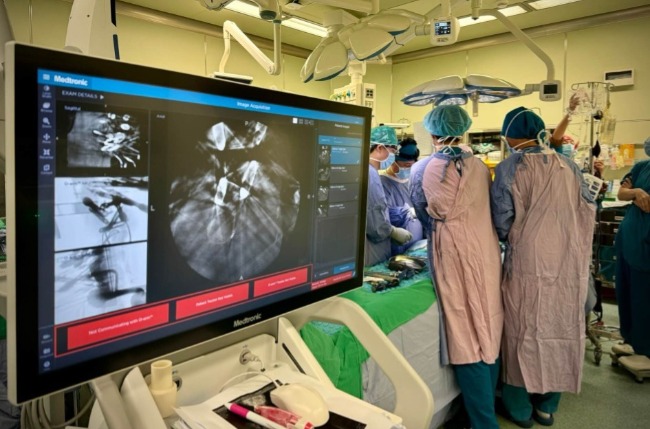
Under the leadership of Dr. Chien-Chun Chang, our team, recognized as "Taiwan's First International Computer Navigation Demonstration Center," has established standardized protocols. Our core competency begins with precise diagnosis, is guided by extensive experience, and is executed safely using the most advanced navigated minimally invasive techniques.
Frequently Asked Questions
Q: I am elderly and have chronic diseases. Is surgery safe for me?
A:This is precisely the advantage of navigated minimally invasive surgery. A comprehensive preoperative workup and anesthesia evaluation are conducted, along with preparatory education to optimize your physical condition. The precision and minimal invasiveness of the procedure lead to less bleeding and reduced physical stress, significantly lowering overall risk.
Q: Will I be in a lot of pain after surgery? Will I need to lie down for a long time?
A:Most patients undergoing navigated minimally invasive surgery can get out of bed wearing a brace the day after surgery, with a typical hospital stay of 2-5 days. Because muscle damage is minimal, pain is significantly reduced. The focus of recovery is on "gradual activity" rather than "prolonged bed rest."
Q:Is it very expensive? Does National Health Insurance cover it?
A:Taiwan's National Health Insurance (NHI) partially covers standard surgery and hospitalization fees. However, special technologies (like navigation systems) and specific medical materials (such as pedicle screws, spinal cages, bone grafts) may require additional out-of-pocket expenses. You are encouraged to discuss the detailed cost structure with your surgeon.
Q:What are the potential complications?
Although computer-navigated minimally invasive spine surgery carries lower risks, potential complications can include wound bleeding, infection, anesthesia-related issues, nerve injury, or fusion failure. Through the standardized surgical protocols of Dr. Chang's team and the precision afforded by advanced navigation equipment, the risks associated with complex surgeries are minimized, ensuring patients receive safe and secure treatment.
Choosing the right surgical approach is a crucial step toward a pain-free life. If you or a loved one is suffering from spinal issues and concerned about traditional surgery, 3D navigated minimally invasive surgery offers a more precise and safer modern alternative.
Welcome to schedule a professional evaluation with the [Dr. Chien-Chun Chang Minimally Invasive Spine & Joint Team]. Let us provide you with an accurate diagnosis and tailor a "precision treatment plan" most suitable for you.