


The Complete Guide to Minimally Invasive Knee Replacement Surgery: Precision Medicine with ROSA Knee Robotic-Arm Navigation - A New Treatment for Degenerative Knee Arthritis
【Article Summary】 With advances in medical technology, minimally invasive knee replacement surgery has entered the "era of digital precision." This article provides an in-depth analysis of how the ROSA Knee (3D Robotic-Arm Navigation System) achieves the goals of "minimizing muscle damage" and "zero-error implant placement" through precise preoperative modeling and real-time intraoperative data monitoring. It addresses patients' key concerns, including the principles of ROSA Knee surgery, out-of-pocket cost estimates, and the 24-hour rapid recovery protocol, to assist you in regaining mobility.
Understanding Minimally Invasive Knee Replacement Surgery: From "Small Incision" to "Ultra-Precision"
Before delving into ROSA Knee surgery, we must first understand what "minimally invasive" truly means. While "traditional" knee replacement surgery often involves more significant tissue disruption, "minimally invasive knee replacement surgery" has significantly increased patient acceptance of knee replacement. This is because the core of minimally invasive surgery lies in:
-
Muscle Sparing: The quadriceps tendon at the front of the thigh is not cut. Instead, access is gained through natural muscle planes.
-
Reduced Bleeding: Shorter surgical time leads to less postoperative swelling and bruising.
-
Rapid Recovery: Shortens the hospital stay, with the goal of enabling patients to walk on the same day or the day after surgery.
Although minimally invasive knee replacement represents a major advancement over traditional surgery, minute visual discrepancies could still occur during the procedure. This changed with the advent of the ROSA Knee robotic-arm system, which has reduced the margin of error in minimally invasive knee replacement to a mere 0.005 cm!
In-Depth Analysis: What is the ROSA Knee 3D Robotic-Arm System?
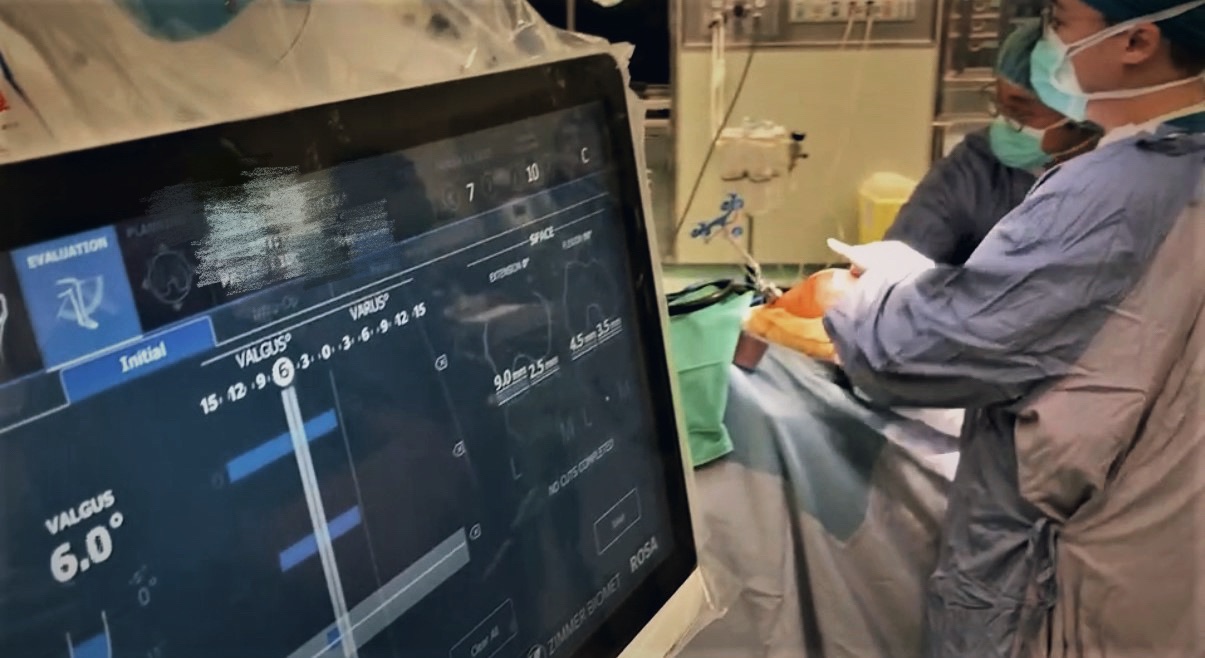
The ROSA Knee (Robotic Surgical Assistant) 3D Robotic-Arm Navigation System is a surgical assistance platform that integrates computer navigation with precision positioning.
Core Operating Principles of ROSA Knee
The ROSA system does not "replace" the surgeon by performing the surgery; instead, it provides the surgeon with precise data support:
-
3D Image Modeling: Using X-rays or CT scans, the system precisely reconstructs a 3D model of the patient's knee joint before surgery, pre-calculating the ideal implant position.
-
Real-Time Dynamic Tracking: During surgery, an optical navigation system continuously tracks the position of the leg. Even if the patient's leg moves slightly, the robotic arm automatically recalibrates.
-
Precision Ligament Balancing: This is an advantage difficult to achieve with conventional surgery. ROSA Knee can measure the ligament tension of the knee joint before implantation, ensuring the restored knee has natural movement and mobility after surgery.
Why Choose ROSA Knee? The Advantages of the 3D Robotic-Arm System
| Metric | Minimally Invasive Surgery | ROSA Knee 3D Robotic-Arm Navigation |
| Accuracy Error | About 0.2-0.3 cm / Over 3 degrees | Controlled within 0.005 cm / Approximately 0.5 degrees |
| Ligament Balance | Based on the surgeon's experience and tactile feel | Quantified through data-driven measurement, achieving perfect mechanical axis alignment |
| Tissue Disruption | Relatively lower | Very low (due to precise positioning that avoids unnecessary dissection) |
| Implant Longevity | Standard (15-20 years) | Longer lifespan (due to even force distribution, reducing wear) |
The Five Major Steps of ROSA Knee 3D Robotic-Arm Surgery
Dr. Chien-Chun Chang's team has standardized the ROSA Knee procedure to ensure every patient receives consistent, high-quality outcomes and can face surgery with peace of mind.
-
-
Preoperative 3D Planning: Knee X-rays are taken, and the data is imported into the system to create a personalized plan based on the patient's unique bone anatomy.
-
Bone Reference Registration: Sensors are attached to the patient's thigh and shin bones, synchronizing them with the ROSA Knee robotic arm for real-time tracking.
-
Soft Tissue Tension Assessment: Before any bone cuts are made, the surgeon moves the joint, allowing ROSA Knee to record ligament tightness at various angles. This helps prevent postoperative joint stiffness.
-
Robotic-Arm Assisted Bone Resection: The robotic arm moves to and locks onto the precise cutting plane. The surgeon then performs the bone cuts along this guided pathway, carefully avoiding nerves and blood vessels.
-
Implantation and Verification: After the artificial joint components are implanted, the computer system is used again to verify the mechanical axis, ensuring perfect alignment from the ankle all the way to the hip.
-
Complete Cost Analysis of ROSA Knee Surgery
Choosing ROSA robotic-arm surgery involves costs beyond just the artificial joint implant materials, including "robotic equipment usage fees" and "surgeon's professional service fees."
Cost Structure Overview (Based on Current Medical Practice in Taiwan)
| Expense Item | Description | Cost |
| National Health Insurance Covered Items | Basic artificial joint materials, partial hospitalization fees | Covered by NHI, patient pays a small co-payment |
| ROSA Surgical Service Fee | Includes 3D modeling, consumables, equipment depreciation | Balance Billing (patient pays the difference) |
| Premium Wear-Resistant Material Surcharge | If upgrading to premium wear-resistant liners or ceramic components | Balance Billing (patient pays the difference) |
| Multimodal Patient-Controlled Analgesia (PCA) | Ensures minimal discomfort within the first 24 hours post-surgery | Optional / Available for selection |
Precision Medicine Budget Recommendation:
For minimally invasive knee replacement surgery, opting for the ROSA Knee 3D robotic-arm system paired with premium wear-resistant components is recommended. An overall budget of approximately NT$ 130,000 to 270,000 is suggested (for reference only; specific treatment costs should be confirmed with your attending physician). While the initial investment is higher, considering the long-term freedom of movement it provides for one's life and the very low revision surgery rate (probability of a second surgery), the overall cost-effectiveness is very high.
ROSA Knee Postoperative Recovery Guide
Because ROSA Knee surgery is minimally invasive to soft tissues, the postoperative rehabilitation process can be significantly shortened.
-
Day of Surgery:
Once the anesthesia wears off, ankle pumps can begin, and bedside rehabilitation can be attempted with pain management support.
-
Within 24 Hours Post-Surgery:
Patients can attempt to walk with the aid of a walker. ROSA Knee ensures initial stability, giving patients the confidence to "take the first step."
-
2 Weeks Post-Surgery:
Sutures are removed or surgical tape falls off. Knee flexion typically reaches 90-100 degrees.
-
6 Weeks Post-Surgery:
Most patients can stop relying on a walker and begin to try brisk walking or stationary bicycle training.
ROSA Knee FAQ (Frequently Asked Questions)
Q: Does the ROSA robotic-arm perform the surgery on its own?
Physician's Answer: No. The entire procedure is performed by Dr. Chien-Chun Chang. The ROSA Knee system acts more like Dr. Chang's "digital navigator" and "high-precision tool." It is responsible for calculating and stabilizing the surgical path, ensuring the surgeon does not deviate from the pre-planned route.
Q: Am I a suitable candidate for ROSA Knee robotic surgery?
Physician's Answer: Almost all patients who require total knee replacement are suitable. It is particularly advantageous for patients with "altered anatomy due to previous injury" or "severe bowlegs (varus) or knock-knees (valgus)," as ROSA Knee's precise calibration system provides significant benefits during their surgery.
Q: Does ROSA Knee surgery carry higher risks?
Physician's Answer: No. On the contrary, because the system features "haptic feedback" and "boundary protection," the robotic arm will automatically stop if the cutting tool moves beyond the planned boundary. This actually significantly enhances surgical safety.
Q: If I pay for ROSA Knee out-of-pocket, will I still need rehabilitation?
Physician's Answer: The ROSA Knee robotic-assisted system pre-calculates the optimal joint tension for you through surgical planning. As a result, extensive initial rehabilitation is often not required, and patients can typically achieve natural knee flexion exceeding 90 degrees within one week after surgery.
?Q: How long will a knee replacement implanted with ROSA Knee last?
Physician's Answer: The primary reason for artificial joint failure is long-term wear caused by incorrect implant positioning. ROSA Knee reduces angular error to a very low level. Combined with highly wear-resistant liners and with proper use and care, the expected lifespan has the potential to exceed 30 years.
Q: Will the surgical incision be larger because of the robotic arm?
Physician's Answer: No. ROSA Knee is a minimally invasive procedure. The incision remains at approximately 8-12 cm, and internal tissue damage is even less, leading to faster recovery.
Conclusion: Dr. Chien-Chun Chang's Team — Choosing the Future for Your Knees
In orthopedic surgery, "close enough" is not good enough. The "ROSA Knee" 3D robotic-arm minimally invasive knee replacement represents the current highest standard in knee replacement. Choosing this technology is not just choosing a procedure; it is choosing longer-lasting joint function and a more natural feeling of movement.If you or a loved one is suffering from knee pain, welcome to schedule an outpatient consultation. Let digital medical technology help you regain the possibility of walking freely again.
Disclaimer: This article is for educational purposes only. Please consult a qualified physician for specific medical advice.