

The Complete Guide to Minimally Invasive Unicompartmental Knee Arthroplasty (UKA): Precision Treatment and Rapid Recovery to Alleviate Knee Degenerative Pain
Knee degeneration is not exclusive to the elderly. Young and middle-aged individuals suffering from long-term degenerative osteoarthritis often worry, "Do I need to replace the entire joint now?" In fact, modern medicine has entered the era of precision medicine. For patients with localized wear, Minimally Invasive Unicompartmental Knee Arthroplasty (UKA) offers an excellent option that preserves the knee joint, involves a small incision, and allows for rapid restoration of mobility.
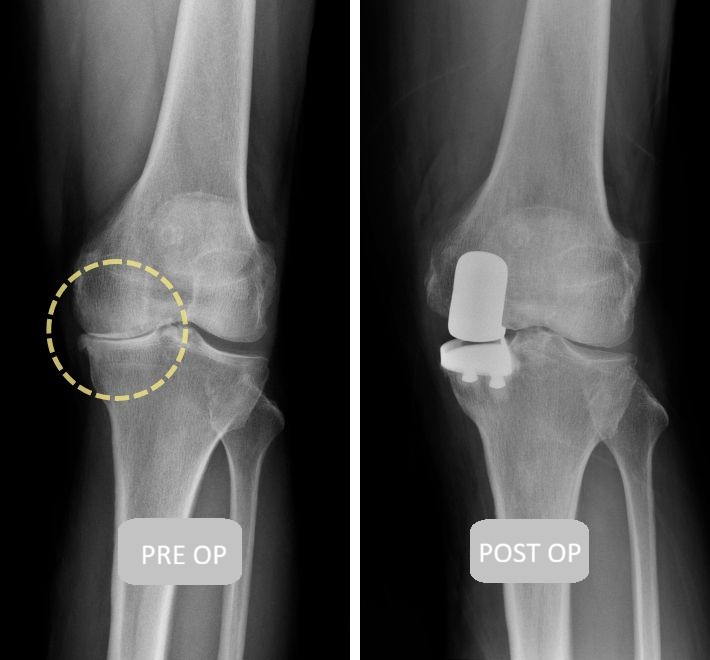
You Don't Need to Replace the Whole Knee for Degeneration: Minimally Invasive Unicompartmental Knee Arthroplasty
When the knee joint degenerates, most people first think of Total Knee Arthroplasty (TKA). However, statistics show that in many patients, the wear is confined to only one compartment (most commonly the medial side).
What is UKA (Unicompartmental Knee Arthroplasty)?
Think of the knee joint as a "three-seater sofa." If only one seat is worn out, we don't need to discard the entire sofa; we can simply refurbish that specific section. UKA operates on this concept of "localized repair." The surgeon only removes the damaged joint surface and implants a small, precise metal spacer, preserving your native bone, cartilage, and the crucial anterior and posterior cruciate ligaments.
Why Choose Minimally Invasive Unicompartmental Knee Arthroplasty (UKA)?
Dr. Chien-Chun Chang's team employs modern surgical techniques that offer the following advantages compared to traditional total knee replacement:
-
Maximum Preservation of Natural Tissue: UKA preserves a greater amount of native bone and the crucial anterior and posterior cruciate ligaments. Clinical studies indicate that this knee-preserving approach helps maintain the knee's natural proprioception, resulting in a postoperative gait and sensation of movement that closely resembles that of a natural knee.
-
Exceptionally Rapid Recovery: Due to the small incision (typically only 6-8 cm) and minimal tissue disruption, most patients can walk within 1-2 days after surgery and return to daily activities within 2-4 weeks.
-
High Safety Profile: For elderly patients or those with chronic conditions who are less suited for prolonged surgery, UKA offers shorter operative times and minimal blood loss, effectively reducing overall surgical risk.
Who is a Suitable Candidate for Unicompartmental Knee Arthroplasty (UKA)? Key Assessment Criteria
Not everyone requires a total knee replacement. Dr. Chien-Chun Chang points out that you should prioritize consideration of UKA if you meet the following conditions:
| Assessment Item | Ideal Condition | Clinical Significance |
| Wear Extent | Localized area (e.g., isolated medial knee pain) | Ensures the remaining joint surfaces are healthy, avoiding the need for extensive replacement |
| Joint Stability | Good ligament function, no severe deformity | Preserving native ligaments maintains knee stability and a natural feel during movement |
| Bone Quality | Good bone density, no severe osteoporosis | Ensures artificial components can integrate tightly with the patient's own bone |
| Patient Population |
Younger/middle-aged patients eager to return to active life, or elderly patients with localized wear |
Meets the demand for "minimally disruptive" surgery across different age groups |
UKA Surgery vs. Other Treatment Options
Within the realm of knee-preserving therapies, common choices besides UKA include High Tibial Osteotomy (HTO), which aims for mechanical axis correction. What are the differences between these two?
Difference in Principle:
-
Unicompartmental Knee Arthroplasty (UKA): Removes the diseased cartilage and bone end, replacing it with an artificial joint while preserving part of the native joint.
-
High Tibial Osteotomy (HTO): Preserves the entire joint by altering the mechanical alignment, focusing on redistributing the load.
Advantage Comparison:
-
Unicompartmental Knee Arthroplasty (UKA): Faster recovery, less pain, excellent efficacy when the indications are clear.
-
High Tibial Osteotomy (HTO): Avoids implantation of artificial materials, preserves the body's own structures, stronger physiological sensation, lower cost.
In summary, based on clinical practice, Dr. Chang will still select the most suitable treatment option between these two for each patient, considering factors such as age, activity demands, type of degeneration, and bone condition.
Comparison Table of Knee-Preserving Surgical Options
| Treatment Characteristic | Minimally Invasive Unicompartmental Knee Arthroplasty (UKA) | High Tibial Osteotomy (HTO) |
| Core Principle | Replaces only the locally worn joint surface | Adjusting the bone angle to transfer load-bearing pressure |
| Pain Relief | Postoperative pain relief is rapid | Symptoms gradually alleviate only after bone healing is complete |
| Weight-Bearing Time | Can attempt walking on the day of surgery or the next day | Requires 6-8 weeks for bone healing before full weight-bearing is possible |
| Ideal Candidate | Middle-aged and elderly patients with degenerative arthritis characterized by significant joint surface wear | Patients with early to mid-stage wear, prominent medial degeneration, good condition in other areas, and a desire to engage in high-intensity sports |
Dr. Chien-Chun Chang's Perspective:
High Tibial Osteotomy (HTO) is suitable for patients who wish to preserve 100% of their natural bone, but it comes with a longer recovery period. On the other hand, Unicompartmental Knee Arthroplasty (UKA) represents the mainstream of modern precision medicine. Due to its fast recovery and high patient satisfaction, it has become the preferred choice for most cases of localized knee degeneration.
Clinical Success Case Study: Unicompartmental Knee Arthroplasty
The Recovery Case of a 64-Year-Old Patient
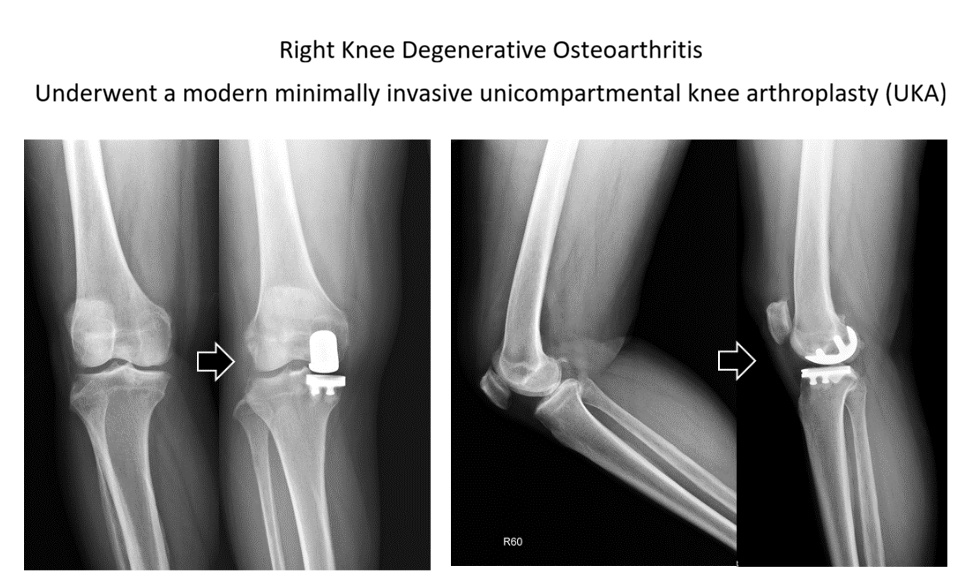
A 64-year-old patient suffered from long-term pain in the inner side of the right knee, making even walking and climbing stairs difficult. After a detailed evaluation by Dr. Chien-Chun Chang of the Minimally Invasive Joint Center, it was determined that the patient's ligament structure was stable and the wear was confined to the medial compartment.
-
Treatment Plan: Underwent modern minimally invasive UKA surgery.
-
Postoperative Outcome: The incision was small with minimal bleeding. Physical therapy began on the first day after surgery, and within two weeks, the patient was already able to walk freely in the park.
Precision Technology: Preoperative Planning and Intraoperative Robotic Assistance
To ensure the long-term durability of the artificial joint, surgeries can now be complemented with robotic-assisted systems. Through precision navigation, surgeons can install components with millimeter (mm) level accuracy, significantly extending the lifespan of the prosthesis.
FAQ: Postoperative Care for Unicompartmental Knee Arthroplasty (UKA)
Q: How soon can I return to normal life after UKA?
Most patients can resume normal walking and light household activities within 2-4 weeks after surgery. With minimally invasive techniques and active rehabilitation, near-normal knee function is often achievable within 6-8 weeks.
Q: How long does a UKA implant last?
With advancements in materials and precise implantation techniques, the 10-year survival rate of modern UKA implants is excellent. To maximize longevity, it is recommended to avoid excessive impact loading, maintain a healthy weight, and attend regular follow-up appointments.
Q: Is special rehabilitation required after UKA?
Early physical therapy is crucial. Your surgeon and rehabilitation team will guide you through strength training and range-of-motion exercises to prevent muscle atrophy and ensure a smooth gait.
This article is for educational purposes only. Please consult a qualified physician for specific medical advice.
References
1. Knee Surg Relat Res. 2018 Mar 1;30(1):28–33. doi: 10.5792/ksrr.17.025
2.LONG TERM RESULTS OF PARTIAL KNEE ARTHROPLASTY. Bone Joint J
2015;(10 Suppl A):9–15.
3.Unicompartmental knee replacement: controversies and technical considerations. Arthroplasty. 2024 May 2;6:21. doi: 10.1186/s42836-024-00242-6