

Herniated Disc Treatment: Can It Heal on Its Own? Spontaneous Recovery & Acute Care Guide
【Article Summary】
Herniated discs are no longer a condition limited to the elderly. With changing lifestyles and an increase in sedentary work, they have become one of the most common spinal issues seen in clinics today. This article will guide you through the following key points in understanding herniated disc treatment:
-
Non-Surgical First:About 80%-90% of patients can achieve improvement within weeks to months through physical therapy, medication, and core strengthening exercises.
-
Red Flags:If you experience loss of bladder/bowel control, numbness in the groin area, or sudden leg weakness/drop foot, these are medical emergencies requiring immediate attention.
-
Precision Medicine Trend:Minimally invasive spine surgery has entered the era of 3D computer navigation (O-arm) , which can control implant placement error to <0.1 cm, achieving the goals of "small incisions, less pain, and faster recovery."
-
Post-Surgery Prevention:Surgery is not the end. Post-surgical spinal care and core muscle training are key to preventing recurrence.
When a doctor tells you, "You have a herniated disc," most patients' first reaction is fear: "Do I need surgery?" "Will surgery cause paralysis?" This article combines the clinical experience of Dr. Chien-Chun Chang's Minimally Invasive Spine & Joint Team to provide you with an authoritative medical guide.
What is a Herniated Disc?
The Function of the Intervertebral Disc
The spine is made up of vertebrae stacked one upon another. Between each pair of vertebrae lies a cushion-like, shock-absorbing structure called the intervertebral disc. This disc is composed of two main parts:
-
Nucleus Pulposus:The soft, gel-like center, rich in water content, responsible for absorbing vertical pressure.
-
Annulus Fibrosus:The tough, outer ring made of multiple layers of strong collagen fibers that contain the nucleus and maintain stability.
When the annulus fibrosus develops tears due to injury, degeneration, or uneven pressure, the inner nucleus can push outward—this is what we call a herniated disc.
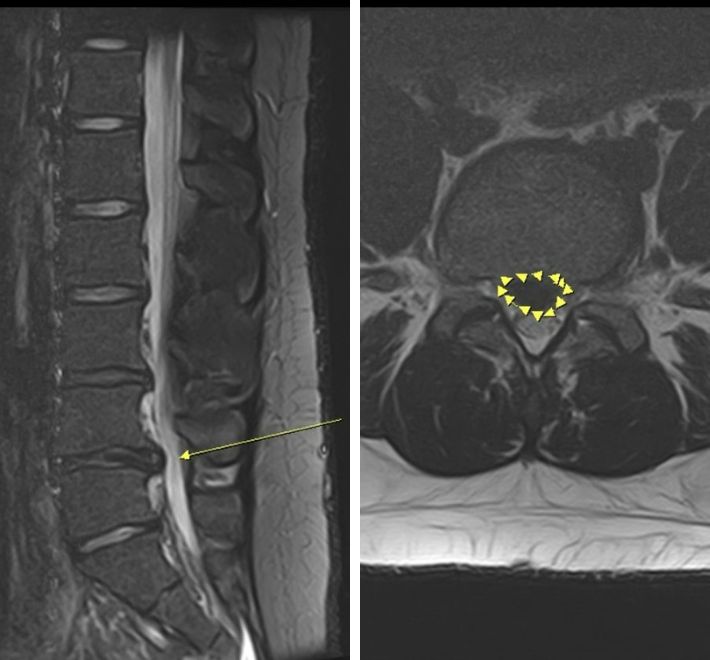
Types of Disc Herniation: Bulging, Protrusion, Extrusion, and Sequestration
Clinically, we classify disc herniation into four stages based on the degree of tissue displacement. This classification helps guide treatment decisions:
-
Bulging:The annulus is still intact but bulges outward, like a tire that's slightly under-inflated.
-
Protrusion:The annulus is partially torn, and the nucleus begins to push out but remains connected to the main disc.
-
Extrusion:The nucleus breaks through the annulus, forming a mass outside the disc space.
-
Sequestration:A fragment of the nucleus breaks off completely and migrates into the spinal canal. This often causes the most severe nerve compression.
Why Does a Herniated Disc Cause Pain?
Pain is not simply caused by "pinching a nerve." In fact, it is triggered by two mechanisms:
-
Mechanical Compression:The herniated tissue directly presses on a nerve root, leading to reduced blood flow and impaired nerve signaling, causing numbness and weakness.
-
Chemical Inflammation:The proteins inside the nucleus are seen as "foreign" by the body's immune system. When they leak out, they trigger a strong inflammatory response. This explains why some patients with only mild compression on imaging can experience severe, debilitating pain.
Typical Symptoms of a Herniated Disc: It’s More Than Just Back Pain
Differences Between Lumbar and Cervical Herniation
Symptoms vary significantly depending on the location of the herniation:
-
Lumbar:Common Sites with L4-L5 or L5-S1. Unilateral sciatica, buttock pain, numbness in the back of the thigh or outer calf.
-
Cervical:Common Sites with C5-C6 or C6-C7. Neck/shoulder stiffness, numbness or tingling in the arms, reduced grip strength, difficulty with fine motor skills (e.g., buttoning a shirt).
Warning Signs of Nerve Compression: From Aches to Muscle Atrophy
Nerve compression often progresses in stages:
-
Sensory Changes: Intermittent ache, progressing to a "shooting" or "burning" sensation.
-
Reduced Reflexes: Physical exam may show diminished knee or ankle reflexes.
-
Motor Dysfunction: Foot drop (inability to lift the front of the foot) or weakness in the big toe.
-
Muscle Atrophy: Long-term compression can lead to visible muscle wasting—a sign of potentially irreversible damage.
Red Flags: When to Seek Immediate Medical Attention
If you experience any of the following symptoms—which may indicate Cauda Equina Syndrome—seek emergency care immediately. Surgery within 24-48 hours is critical to prevent permanent disability:[1]
-
Loss of bowel or bladder control (incontinence or difficulty urinating).
-
Numbness or loss of sensation in the groin area (saddle region) .
-
Sudden, severe weakness in both legs.
What Causes a Herniated Disc?
Dr. Chang reminds us that disc herniation is often the result of "cumulative wear and tear" combined with "a sudden stress event."
Degenerative Factors
As we age, the water content of the disc decreases, and the annulus becomes more brittle and prone to cracks. This is a natural aging process, but we are now seeing this degeneration occur at younger ages.
Lifestyle Factors
Prolonged sitting, heavy lifting, and poor posture are major contributors. While seated, the pressure on the lumbar spine is 1.5 times higher than when standing; slouching can increase this to 2.5 times.
Genetic and Smoking Factors
Smoking can accelerate disc degeneration by constricting the tiny blood vessels that supply the spine. Genetics can also play a role, with some individuals having a weaker collagen structure that makes them more prone to disc tears. [2]
Diagnostic Process: How to Accurately Locate the Lesion
-
Physical Examination: The Straight Leg Raise Test (SLRT) is a classic test. With the patient lying flat, the doctor lifts the painful leg. If pain radiates down the leg between 30° and 70°, it strongly suggests a lumbar disc herniation.
-
Imaging Studies:
-
X-Ray: Although it can't directly show the disc, it helps assess spinal alignment, disc space narrowing, and stability.
-
CT Scan: Provides excellent bone detail, useful for evaluating calcification.
-
MRI: This is the gold standard. It clearly shows the extent of herniation, water content, and which nerve roots are compressed. [3][4]
-
-
Electromyography (EMG) and Nerve Conduction Studies: Used when imaging doesn't match symptoms, to confirm nerve damage and its severity.
Non-Surgical Treatment Options for Herniated Discs
Most patients' primary concern upon diagnosis is whether they will need surgery. In reality, the majority of patients improve significantly with non-surgical treatments over a period of weeks to months.
-
Acute Phase Management (Medication & Physical Therapy): Focus is on reducing inflammation and pain. Treatments may include NSAIDs, muscle relaxants, and medications for nerve pain (e.g., Gabapentin). Physical therapy can involve heat/electrical therapy to promote circulation and relax muscles.
-
Manual Therapy & Exercise: Once pain subsides, the focus shifts to restoring function. Lumbar traction can create negative pressure to encourage the disc to retract.[5][6] Core stabilization exercises (such as the McKenzie Method or Pilates) strengthen deep abdominal and back muscles to build a natural "lumbar belt."
-
Interventional Procedures: For pain not controlled by medication, Epidural Steroid Injections (ESI) can deliver powerful anti-inflammatory medication directly to the site of nerve compression.
Minimally Invasive Surgical Options for Herniated Discs
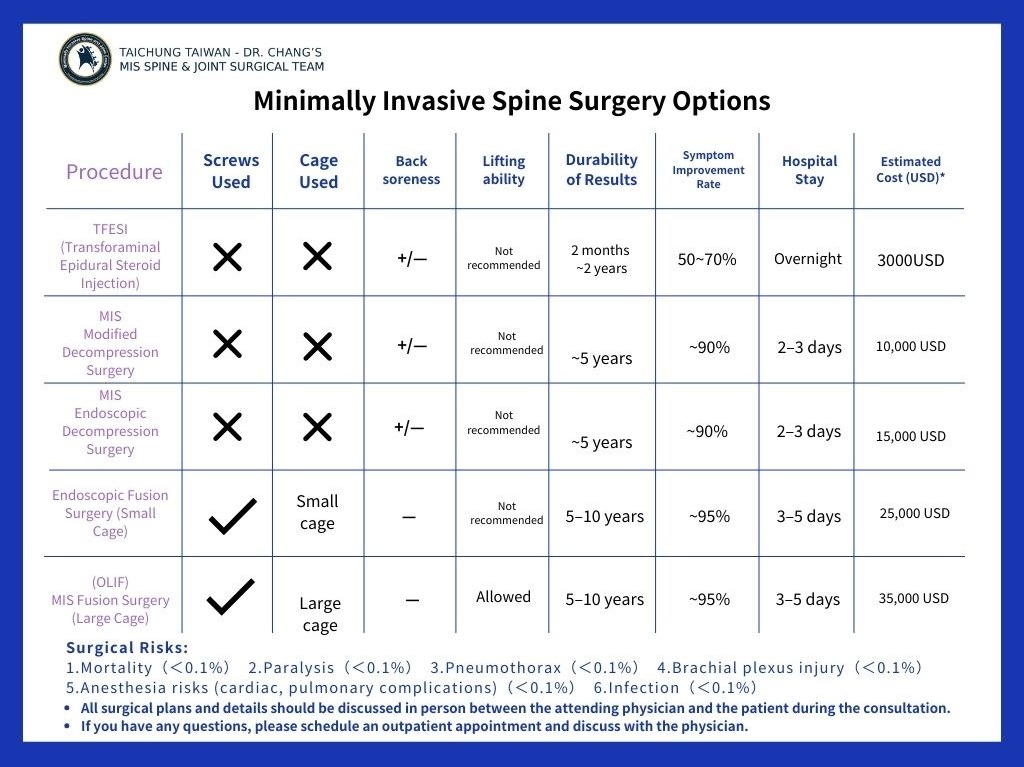
When conservative treatment fails, pain severely impacts quality of life, or there is neurological decline (weakness, muscle atrophy), surgery becomes necessary. Dr. Chang emphasizes that modern surgery has moved beyond large incisions and long recoveries, entering the era of "precision minimally invasive" techniques.
Traditional Open Surgery vs. Microdiscectomy vs. Endoscopic Surgery
-
-
Traditional Open Surgery: 5-10 cm incision, significant muscle disruption, slow recovery.
-
-
-
Microdiscectomy: Minimally invasive, using a microscope for a ~3 cm incision. A common standard procedure.
-
Endoscopic Spine Surgery: The most advanced, with an incision of only ~0.8 cm (about the size of a pen tip) . The herniated disc is removed directly through a scope with minimal disruption to spinal stability. Patients often walk the same day and recover much faster.
-
3D-Computer-Assisted Minimally Invasive Lumbar Fusion (MIS-TLIF)
For patients with spinal instability or spondylolisthesis, simply removing the disc is not enough; the segment also needs to be stabilized. Intraoperative 3D CT (O-arm) and navigation systems allow for precise screw and cage placement with an error of <0.1 cm.
Indications for Surgery: When Is It "Unavoidable"? [7]
-
Failed Conservative Treatment: Symptoms worsen after 6-12 weeks of rehabilitation.
-
Progressive Neurological Deficit: Muscle weakness or atrophy continues to decline.
-
Cauda Equina Syndrome: This is an absolute emergency requiring immediate surgery.
Post-Surgical Rehabilitation and Prevention
The end of surgery is just the beginning of recovery. Post-surgical "spinal management" is crucial to prevent recurrence.
Post-Surgical Rehabilitation Timeline
-
Weeks 1-2: Focus on wound care, rest.
-
After Week 2: Begin flat-surface walking; avoid bending and lifting.
-
Weeks 4-8: Start core-strengthening exercises with a physical therapist.
-
After 2 Months: Gradually return to low-impact sports (e.g., swimming).
Ergonomics for Spine-Friendly Environment
-
Lift Correctly: Never bend at the waist; use your legs.
-
Sit Smart: Maintain a 90° angle at hips and knees. Use a chair with good lumbar support.
-
Take Breaks: Stand and move around every 30-50 minutes.
Frequently Asked Questions (FAQ)
Q: Can a herniated disc heal on its own?
Dr. Chang: Yes, for certain types, "spontaneous regression" is possible. Studies show an overall regression rate of 70.39% , with the process mainly occurring within 6 months of conservative treatment. "Ruptured" discs (extrusion, sequestration) have a higher chance of shrinking than non-ruptured ones.[8] The nucleus contains a high water content and, when exposed to a well-vascularized area, the body's immune cells can break it down.
Q: Are inversion tables or traction effective?
Dr. Chang: Lumbar traction can reduce pressure and offer relief, especially in the acute phase. A 2025 study in Brain and Spine confirmed that traction is highly effective at improving pain and mobility, outperforming exercise or manual therapy alone. [9] However, inversion tables are not recommended for those with high blood pressure, glaucoma, or heart conditions. Traction should only be performed under professional supervision.
Q: Can I exercise or lift weights with a herniated disc?
Dr. Chang: Yes, but only at the right time and with the right techniques. While acute pain is present, avoid heavy lifting. Once pain resolves, you can start with low-impact exercises that strengthen the deep core muscles (e.g., lat pulldown for back muscles). Work with a professional coach and gradually increase intensity. [10]
Q: Can I wear a back brace for a long time?
Dr. Chang: No. Over-reliance on a brace can lead to "disuse atrophy" of your core muscles, making your spine less stable. Use a brace only during acute pain or for heavy lifting. Aim to wean off it within 2-3 months, gradually relying on your own muscles for support. [11]
Q: How long is the recovery after minimally invasive surgery?
Dr. Chang: For endoscopic surgery, patients typically walk the same day or the next day. Most can return to office work within 1-2 weeks. For manual labor, we recommend waiting at least 4-6 weeks. Studies show that approximately 70-80% of patients return to work within 1.5 months post-surgery. [12]
Dr. Chien-Chun Chang's Concluding Thoughts
Fear of a herniated disc often stems from the unknown. Today's spine care has entered the era of precision, utilizing 3D computer navigation and endoscopic techniques—a perfect blend of technology and surgical skill. But remember, the most powerful medicine begins with daily habits: maintaining good posture and building a strong core are the foundation for a lifetime of spinal health.
This article is for educational purposes only. Please consult a qualified physician for specific medical advice.
【References】
[1] Kumar V, Baburaj V, Rajnish RK, Dhatt SS. Outcomes of cauda equina syndrome due to lumbar disc herniation after surgical management and the factors affecting it: a systematic review and meta-analysis of 22 studies with 852 cases. Eur Spine J. 2022 Feb;31(2):353-363. (Key Evidence: Symptoms <48 hrs, better bladder function recovery.)
[2] Hoffeld K, Lenz M, Egenolf P, et al. Patient-related risk factors and lifestyle factors for lumbar degenerative disc disease: a systematic review. Neurochirurgie. 2023 Sep;69(5):101482. (Key Evidence: Smoking increases risk 3.8x, diabetes 6.8x, family history 4.0x.)
[3] Madhesh M, Eapen C, Eappakkam Kumaraswamy P, Palaniswamy V. Diagnostic accuracy of the compression overload test versus straight leg Raise test... Eur Spine J. 2025 Oct;34(10):4377-4385. (Key Evidence: MRI as gold standard for diagnosis.)
[4] Han CS, Hancock MJ, Sharma S, et al. Low back pain of disc, sacroiliac joint, or facet joint origin... EClinicalMedicine. 2023 May;59:101960. (Key Evidence: MRI findings can confirm disc as pain source.)
[5][6][9] Thavarajasingam SG, et al. Exercise, manipulation and traction physiotherapy in the conservative management of lumbar disc herniation... Brain Spine. 2025;5:105632. (Key Evidence: Traction most effective conservative treatment.)
[7] Thavarajasingam SG, et al. Indications for surgery versus conservative treatment... Brain Spine. 2025;5:105619. (Key Evidence: Surgical indications defined.)
[8] Zou T, Liu XY, Wang PC, et al. Incidence of Spontaneous Resorption of Lumbar Disc Herniation: A Meta-analysis. Clin Spine Surg. 2024 Jul 1;37(6):256-269. (Key Evidence: 70.39% spontaneous resorption rate overall.)
[10] Du S, et al. Clinical efficacy of exercise therapy... Front Med. 2025;12:1531637. (Key Evidence: Exercise therapy effective for pain and function.)
[11] Wei X, Chen F, Yu C, et al. Effectiveness of lumbar braces after lumbar surgery... Arch Orthop Trauma Surg. 2024 Apr;144(4):1523-1533. (Key Evidence: Brace use may lead to muscle atrophy.)
[12] Yong JH, Wang E, Chin BZ, et al. Full-endoscopic versus microscopic lumbar discectomy... Spine J. 2026 Jan 7. (Key Evidence: Endoscopic surgery shorter recovery by 2.2 days hospital stay.)
Author & Medical Review: Chien–Chun Chang, MD, PhD
【Taiwan's Pioneer in Computer-Navigated Spine Endoscopy】
Dr. Chang is the first surgeon in Taiwan to demonstrate computer-assisted navigated spinal endoscopic surgery, advancing the precision and safety of minimally invasive spine surgery.His research, "Computer-assisted Navigation in Spine Endoscopy," was published in BMC Musculoskeletal Disorders (2020, Impact Factor 2.4), providing important clinical evidence supporting computer-assisted minimally invasive spine surgery.
【Areas of Expertise】
Minimally Invasive Spine Surgery
- Cervical and lumbar endoscopic spine surgery
- 3D computer-assspine surgery
- Complex revision spine surgery
- Scoliosis correction
- Spine fracture surgery
Navigation Surgery
- Robot-assisted knee replacement (ROSA Knee)
- Minimally invasive total knee replacement
- Minimally invasive total hip replacement
Pain Management & Regenerative Medicine
- Sciatica
- Herniated disc
- Chronic low back pain
- Regenerative treatment for osteoarthritis
- Osteoporosis management
【Professional Appointments】
- Assistant Superintendent & Chief of Orthopedic Surgery
Taichung Municipal Senior Rehabilitation General Hospital - Ministry of Education Certified Assistant Professor
- Board Member (13th Term)
Taiwan Society of Minimally Invasive Spine Surgery (TSMISS) - Board Member (5th Term)
Taiwan Society of Endoscopic Spine Surgery (TSESS)