

How to Choose Surgery for a Herniated Disc? Understanding the Principles, Advantages, and Disadvantages of Decompression vs. Fusion
Author & Reviewer: Dr. Chien-Chun Chang | Board-Certified Orthopedic Surgeon
【Article Summary】Key Answers from Dr. Chien-Chun Chang
The core of modern spine surgery lies in customized precision medicine. Surgeons strike a balance between "repair" and "reinforcement" based on your spinal stability.
-
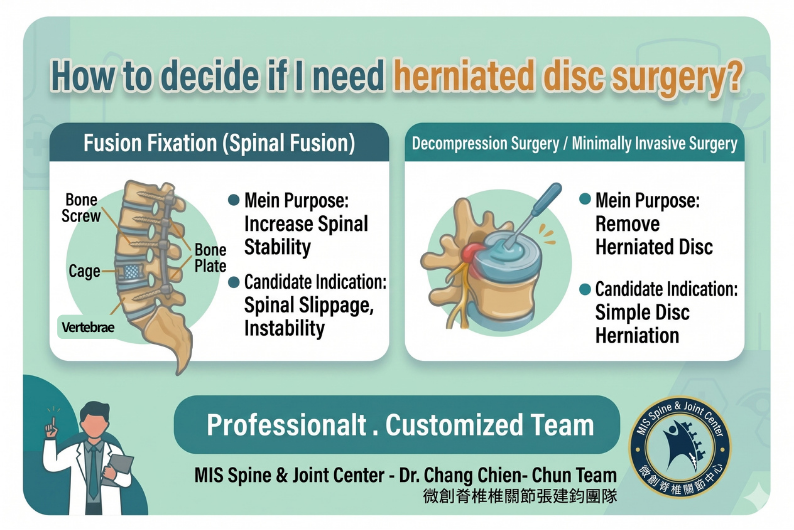
Decompression Surgery (Repair): Removes the herniated material compressing the nerve. Small incision (<1.5 cm), fast recovery. Suitable for simple disc herniation with a stable spinal structure.
-
Fusion and Fixation Surgery (Reinforcement): Reconstructs spinal stability using interbody cages and screws. Suitable for patients with spondylolisthesis or severe instability.
-
Key Decision Factor: If the spine is stable, "decompress when possible, avoid fusion" is the mainstream consensus to prevent accelerated degeneration of adjacent segments.
-
Postoperative Recovery: Decompression surgery typically allows discharge within 1–2 days, with a soft lumbar brace worn for 3 months. Fusion surgery requires 3–5 days of hospitalization, with a rigid back brace worn for approximately 3 months.
When Does a Herniated Disc Require Surgery? [1]
When you experience the following symptoms, it typically indicates that nerve compression has reached a critical threshold, and surgery must be arranged:
- Cauda Equina Syndrome: Incontinence of bowel or bladder, or numbness in the perineal area (this is an indication for emergency surgery).
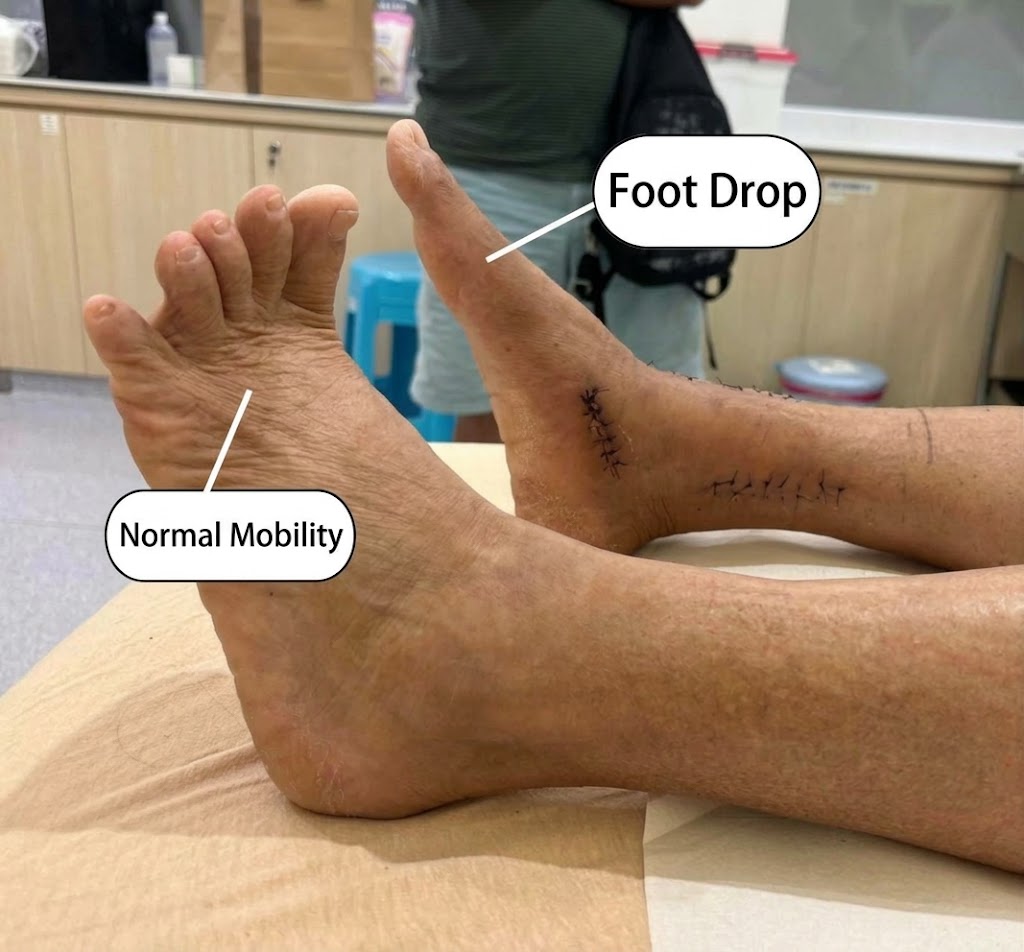
- Muscle Atrophy: Lower limb weakness, foot drop.
- Intractable Pain: Failure to respond to 6–12 weeks of conservative treatment, severely affecting sleep and work.
- Related Article:【Herniated Disc】Can It Heal on Its Own? A Guide to Self-Healing Probability and Acute Phase Relief
Treatment Logic for Herniated Discs: Repair vs. Reinforce
The intervertebral disc sits between two vertebral bodies and acts as a "shock absorber."
1. Treatment Option A: Decompression Surgery (Repair)
When the disc—this shock absorber—herniates due to trauma or degeneration and compresses a nerve, we can directly "remove the source of compression." The goal is to clean up the herniated portion causing the problem while preserving the spine's original structure and mobility. (This is like repairing a damaged tire rather than replacing the entire tire.)
2. Treatment Option B: Fusion Surgery (Reinforce)
If the patient's spine not only has a herniated disc but also "spondylolisthesis" or "structural instability" (meaning the vertebrae slide abnormally against each other), simply removing the herniated material (bone spurs, disc fragments) will not solve the problem. In this case, the "reinforce" logic must be adopted—using interbody cages and screws to fuse the vertebrae together and rebuild the spine's supporting strength.
Minimally Invasive Decompression Surgery vs. Spinal Fusion and Fixation Surgery
1. Minimally Invasive Decompression Surgery
- Clinical Advantages: Does not disrupt large areas of muscle and ligaments, resulting in mild postoperative pain. According to clinical observations, most patients can get out of bed once the anesthesia wears off, with a hospital stay typically of only 1–2 days.
- Key Value: Preserves the range of motion of the original segment, which is particularly important for young and middle-aged patients with high activity demands.
2. Fusion and Fixation Surgery
- Clinical Advantages: Fusion surgery can substantially resolve lower back pain caused by degenerative wear and structural instability. The incision is approximately 3–5 cm, with a recovery period of 3–5 days. For elderly patients with severe degeneration or those with spondylolisthesis, this represents a durable, long-term solution.
- Technological Evolution: Today's "minimally invasive fusion surgery" has an incision of approximately 3–5 cm. When combined with endoscopy, the incision can even be reduced to 0.8–1 cm, achieving the same fixation effect while reducing blood loss.
| Comparison Item |
Decompression Surgery |
Fusion and Fixation Surgery |
|
Surgical Incision |
Approximately 1.0–1.5 cm |
Approximately 3–5 cm (minimally invasive fusion) Approximately 0.8–1 cm (endoscopic fusion)
|
|
Surgical Time |
Approximately 1–1.5 hours |
Approximately 2.5–4 hours |
|
Hospital Stay |
1–2 days |
4–6 days |
|
Postoperative Brace |
Soft lumbar belt |
Rigid back brace |
Key Decision: Why Is Fusion Surgery Not Recommended Prematurely? [2]
When facing two surgical options, patients often ask: "Since fusion is more stable, why not just go straight to fusion?"
Adjacent Segment Degeneration
This involves a critical issue: adjacent segment degeneration. The human spine functions as a connected chain. If we fuse one segment of the spine, the motion and stress originally shared by that segment are transferred to the adjacent segments above and below, which accelerates wear on the discs at those adjacent levels.
According to a 2025 systematic review published in the Journal of Orthopaedic Surgery & Research, among patients who underwent lumbar fusion surgery, approximately 36% developed radiographic adjacent segment degeneration within 2 to 7 years, and 11% developed symptoms requiring clinical management. Years later, the probability of developing new problems at adjacent segments is significantly higher than with decompression surgery alone.
Decompress When Possible, Avoid Fusion
Through the literature, we can understand the potential cost of performing fusion too early: transferring stress to adjacent healthy segments, which may lead to new pathologies and the need for additional surgery. Therefore, when the spinal structure remains stable, "decompress when possible, avoid fusion" is the current medical consensus.
Herniated Disc Surgery FAQ
Q:Is recurrence common after minimally invasive decompression surgery?
The recurrence rate after minimally invasive decompression surgery is not significantly different from that of traditional decompression surgery. The key factor in recurrence is usually improper postoperative posture or insufficient core muscle strength, rather than the surgical technique itself.
【Key Evidence】
According to a 2026 large-scale analysis (covering 39 studies and over 14,000 patients), approximately 11% of patients who underwent endoscopic spine surgery experienced recurrence after surgery. However, the study also found that recurrence is not random—it is associated with several factors, including engaging in strenuous exercise too soon after surgery, smoking, diabetes, being overweight, and intraoperative findings of annular tears.[3]
Q: How soon after disc surgery can I start exercising?
張建鈞醫師回答:
-
Minimally Invasive Decompression Surgery: In the early postoperative period, simple walking and daily activities can be performed under patient education guidance. Structured exercise can typically begin approximately 4–6 weeks later.
-
Fusion and Fixation Surgery: The early postoperative period focuses on progressive activity under patient education guidance. Formal strength training and increased exercise intensity are recommended to begin 2–3 months after surgery.
※ Actual progress depends on individual conditions and should be initiated after evaluation by the attending physician.
Q: Is minimally invasive surgery covered by National Health Insurance?
The surgery itself is typically covered by National Health Insurance, but endoscopic consumables or specific medical materials usually require out-of-pocket payment.
Q:Can a lumbar herniated disc heal on its own?
Some degrees and types of disc herniation do have the potential for "spontaneous resorption." Studies show that the overall spontaneous resorption rate for herniated discs is 70.39% , with the resorption process mainly occurring within 6 months of conservative treatment. Among these, ruptured types (extrusion, sequestration) have a significantly higher spontaneous resorption rate than non-ruptured types. Therefore, it mainly depends on the type of disc herniation.[5]
Q:Do I have to wear a brace after surgery?
Decompression surgery only requires wearing a soft lumbar belt for 1 month to protect the muscles. Fusion surgery requires wearing a rigid back brace for 2–4 months to ensure stable bone healing. Although a lumbar brace can provide support, long-term use is not recommended, as it may lead to back muscle weakness and actually make the spine more unstable.[6]
Conclusion: Returning Life to Normal, Not Just "Repairing" the Spine
For the treatment of herniated discs, whether choosing decompression or fusion, the key lies in "precise diagnosis." Please be sure to have a detailed discussion with a professional spine surgery team to choose the plan that best protects your long-term spinal health.
This article is for educational purposes only. Please consult a qualified physician for specific medical advice.
Literature Review:
1. Thavarajasingam SG, et al. Indications for surgery versus conservative treatment in the management of lumbar disc herniations: A systematic review. Brain Spine. 2025;5:105619. doi: 10.1016/j.bas.2025.105619.
【Key Evidence】
According to a 2025 systematic review published in the Brain and Spine journal, after analyzing 20 high-quality studies, researchers clearly identified three major dimensions of surgical indications for lumbar disc herniation:
-
Failure of Conservative Treatment: 12 studies listed this as a criterion for conversion to surgery, with the most common observation period being 4–6 weeks.
-
Neurological Deterioration: Early surgery (within 48 hours to 6 weeks) achieved a recovery rate exceeding 90% in patients with mild to moderate motor deficits.
-
Cauda Equina Syndrome: Consistently regarded in the literature as an absolute surgical indication.
The study also emphasized that the criteria for converting to surgery should include: failure of conservative treatment, progression of neurological symptoms, and worsening on imaging—fully consistent with the three core considerations in clinical decision-making.
2. Haibier A, Wang J, Liu W, Wang G. Comprehensive identification of risk factors for recurrence after percutaneous endoscopic lumbar discectomy: a systematic review and meta-analysis. Front Surg. 2026 Apr 7;13:1733796. doi: 10.3389/fsurg.2026.1733796. PMID: 41953493; PMCID: PMC13055515.
【Key Evidence】According to a 2025 systematic review published in the Journal of Orthopaedic Surgery & Research (covering 87 articles), within 2 to 7 years after lumbar fusion surgery, approximately 36% of patients developed radiographic adjacent segment degeneration, and 11% developed symptoms requiring clinical management.The primary cause of adjacent segment degeneration after fusion is the unavoidable ligament and muscle damage during surgery, combined with the loss of mobility at the fused segment, which forces adjacent segments to bear compensatory additional motion and stress.Through the literature, we can understand the potential cost of performing fusion too early: transferring stress to adjacent healthy segments, which may lead to new pathologies and additional surgery. Therefore, when the spinal structure remains stable, "decompress when possible, avoid fusion" is the current medical consensus.
3. Haibier A, Wang J, Liu W, Wang G. Comprehensive identification of risk factors for recurrence after percutaneous endoscopic lumbar discectomy: a systematic review and meta-analysis. Front Surg. 2026;13:1733796. doi: 10.3389/fsurg.2026.1733796
【Key Evidence】
According to a 2026 large-scale analysis (covering 39 studies and over 14,000 patients), approximately 11% of patients who underwent endoscopic spine surgery experienced recurrence after surgery. However, the study also found that recurrence is not random—it is associated with the following factors:
-
Engaging in strenuous exercise too soon after surgery: Places excessive pressure on the newly repaired disc.
-
Smoking: Affects tissue blood supply and healing capacity.
-
Diabetes: Poor blood sugar control reduces the body's repair function.
-
Being overweight: Increases long-term stress on the spine.
-
Intraoperative findings of annular tears: These patients have a higher risk of recurrence.
In other words, the surgical technique itself is only one factor influencing recurrence. Postoperative lifestyle habits and health management are equally critical. This is why Dr. Chien-Chun Chang's team places special emphasis after surgery on: maintaining proper posture, avoiding premature strenuous activity, quitting smoking, and controlling weight and blood sugar—all of which you can actively manage to effectively reduce the risk of recurrence.
4. Barbosa TP, et al. Rehabilitation after cervical and lumbar spine surgery. EFORT Open Rev. 2023;8(7):570-580. doi: 10.1530/EOR-23-0015.
【Key Evidence】
According to this 2023 review of rehabilitation research, the recommended recovery progression is as follows:
-
Minimally Invasive Decompression Surgery: In the early postoperative period, simple walking and daily activities can be performed (under patient education guidance). Approximately 4–6 weeks later, a structured rehabilitation program can begin, starting with core strengthening exercises.
-
Fusion and Fixation Surgery: Because bone healing must be awaited, the rehabilitation pace is slower. The early postoperative period focuses on progressive activity. Formal spinal rehabilitation and increased exercise intensity are typically recommended to begin 2–3 months after surgery.
※ Actual progress depends on individual wound healing and should be initiated after evaluation by the attending physician.
5. Zou T, Liu XY, Wang PC, Chen H, Wu PG, Feng XM, Sun HH. Incidence of Spontaneous Resorption of Lumbar Disc Herniation: A Meta-analysis. Clin Spine Surg. 2024 Jul 1;37(6):256-269. doi: 10.1097/BSD.0000000000001490. Epub 2023 Jul 31. PMID: 37559207.
Xie L, et al. Prevalence, clinical predictors, and mechanisms of resorption in lumbar disc herniation: a systematic review. Orthop Rev (Pavia). 2024 Sep 21;16:121399. doi: 10.52965/001c.121399. PMID: 39944739; PMCID: PMC11820193.
【Key Evidence】
According to a 2024 meta-analysis published in Clinical Spine Surgery (covering 31 studies and 2,233 patients), the study confirmed that after conservative treatment for lumbar disc herniation, the overall spontaneous resorption rate reached 70.39%.The resorption process mainly occurs within 6 months of conservative treatment. Another systematic review also confirmed an overall resorption rate of 76.6%. The core mechanism is: after the herniated nucleus pulposus enters the epidural space, it triggers an inflammatory and immune response, leading to phagocytosis and breakdown by macrophages. Therefore, certain types of disc herniation do have the potential for "spontaneous resorption," but this depends on the type and degree of herniation—consistent with Dr. Chien-Chun Chang's clinical observations.
6. Wei X, Chen F, Yu C, Huang S, Ou J, Mu X, Wei J. Effectiveness of lumbar braces after lumbar surgery: a systematic review and meta-analysis. Arch Orthop Trauma Surg. 2024 Apr;144(4):1523-1533. doi: 10.1007/s00402-024-05219-3. Epub 2024 Feb 16. PMID: 38363322.4.
Pathak N, Scott MC, Galivanche AR, et al. Postoperative bracing practices after elective lumbar spine surgery: A questionnaire study of U.S. spine surgeons. N Am Spine Soc J. 2021 Feb 27;5:100055. doi: 10.1016/j.xnsj.2021.100055. PMID: 35141620; PMCID: PMC8820027.
【Key Evidence】
1. Long-term brace use may lead to muscle atrophy
According to a 2024 systematic review and meta-analysis published in the Archives of Orthopaedic and Trauma Surgery (including 10 studies and 717 patients), the study indicated that using a brace after lumbar surgery may lead to lumbar muscle atrophy, affecting the long-term stability of the spine.
2. Clinical wearing recommendations from surgeons
A 2021 survey of U.S. spine surgeons showed that among surgeons who used braces, the majority recommended wearing them for 2–4 months after surgery.
Author & Medical Review: Chien–Chun Chang, MD, PhD
【Pioneer in Spine Endoscopic Surgery in Taiwan】
The first physician in Taiwan to demonstrate computer-assisted navigation in spine endoscopy, dedicated to improving the precision and safety of spine and joint surgery.His research, “Computer-assisted navigation in spine endoscopy,” was published in 2020 in the internationally recognized medical journal BMC Musculoskeletal Disorders (IF: 2.4), providing important evidence-based support for minimally invasive surgery.
【Minimally Invasive Joint Reconstruction Team】
Dr. Chang received specialized training in minimally invasive robotic-assisted joint replacement surgery in Japan and led his team to obtain international training certification for the ROSA robotic system. He subsequently established the International Robotic Minimally Invasive Joint Replacement Center and Training Demonstration Site.
【Areas of Expertise】
.Joint Reconstruction and Replacement: Robot-assisted minimally invasive knee replacement (ROSA Knee), minimally invasive total knee and hip replacement.
.Minimally Invasive Spine Surgery: Minimally invasive endoscopic surgery of the cervical and lumbar spine, 3D computer-navigated minimally invasive spine surgery, complex revision spine surgery and scoliosis correction, and spine fracture surgery.
.Pain Management and Regenerative Medicine: Sciatica, herniated discs, chronic low back pain, regenerative treatment for degenerative joint disease, and osteoporosis.
【Current Positions and Professional Experience】
.Taichung Municipal Elderly Rehabilitation General Hospital|Assistant Vice President & Director, Department of Orthopedics
.Ministry of Education, Taiwan|Assistant Professor
.Taiwan Society of Minimally Invasive Spine Surgery (TSMISS)|Current Board Member
.Taiwan Society of Endoscopic Spine Surgery (TSESS)|Current Board Member
.2024 National Quality Seal (SNQ)|Project Leader, A New Milestone in Spine and Joint Surgery for Older Adults: A Standardized Fast-Recovery Protocol
.2023 National Quality Seal (SNQ)|Project Leader, Standardized Protocol for Computer Navigation in Complex Spine Surgery
.Taichung Medical Association|10th Medical Contribution Award – Excellence in Professional Advancement
.ROSA Robotic System|International Robotic Training and Education Certified Instructor
.Medtronic|Director, International Computer Navigation Demonstration Center / International Lecturer in Computer-Navigated Spine Surgery
.2025 CAOS AP Faculty|International Committee Member, Asia-Pacific Computer-Assisted Orthopedic Surgery Conference
.ESPINEA|Asia-Pacific Faculty
.AO Spine Asia Pacific|Selected Fellow