

Uniportal versus Biportal Endoscopic Lumbar Surgery: A Comparative Analysis of Advantages, Disadvantages, and Surgical Perspectives
【Article Summary】
Spine surgery is a major decision for most people. This article provides an in-depth comparison of the two current mainstream endoscopic techniques: Uniportal and Biportal.
-
-
Uniportal technique pursues minimal invasiveness and preserves muscle tissue.
-
Biportal technique offers a more flexible surgical field of view, allowing it to address more complex problems.
-
Both approaches share the advantages of small incisions (under 1 cm) , rapid recovery, and minimal blood loss.
-
When You're Facing Spine Surgery, Here's What We Want You to Know:
When you seek medical attention for long-term sciatica, numbness, or weakness in your legs while walking, and your physician mentions "endoscopic spine surgery," we fully understand your concerns about undergoing an operation. Endoscopic spine surgery has now entered the era of "precision minimally invasive medicine," and "uniportal" and "biportal" are the two most frequently asked-about techniques in clinical consultations. Below, we explain the differences between them and the situations in which each is most suitable.
Uniportal Endoscopic Surgery: The Precision Choice for Ultimate Minimally Invasive Treatment
Surgical Logic: Single-Point Access, Maximum Protection
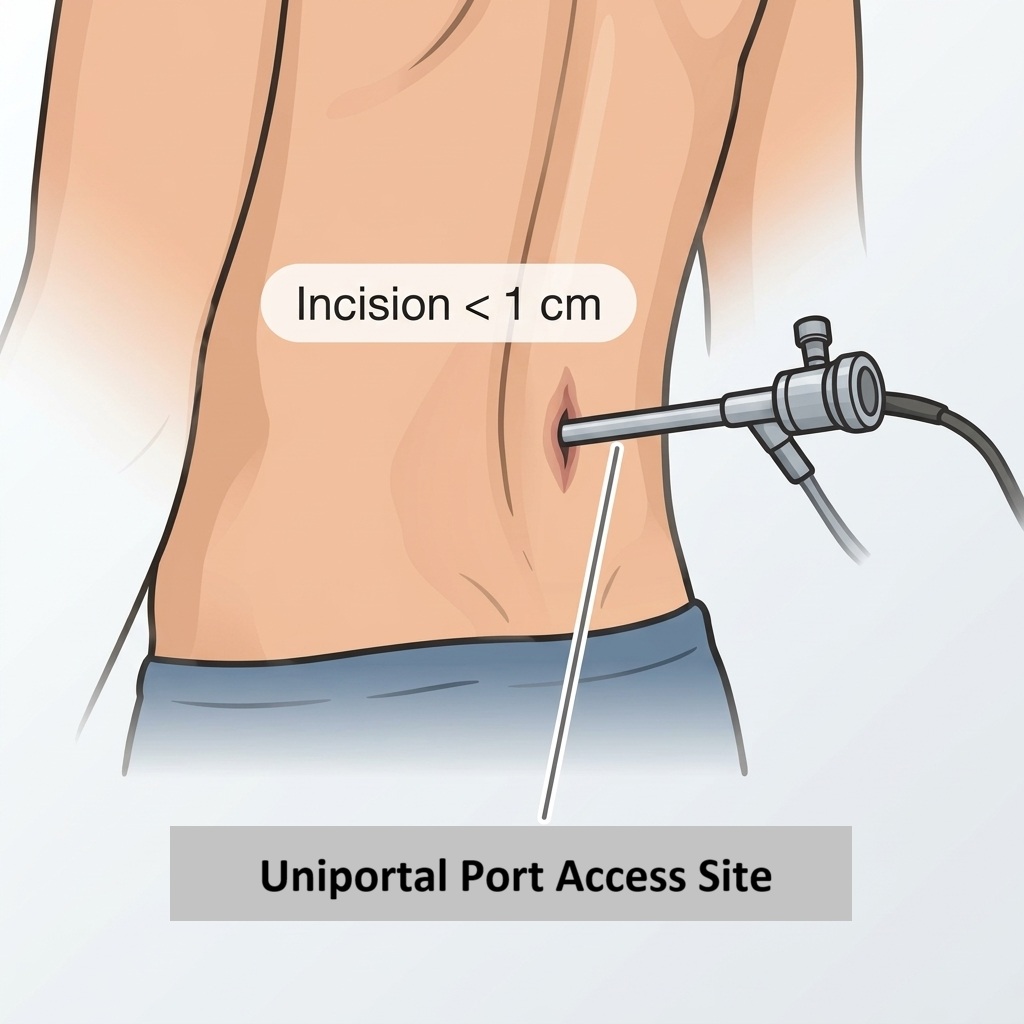
The uniportal technique uses a single incision of less than 1 cm to simultaneously introduce a high-definition camera and surgical instruments directly into the lesion for the procedure.
-
Medical Advantages
Because there is only one small incision, the surgeon does not need to extensively strip the multifidus muscle, which protects the spine. This significantly reduces the risk of postoperative muscle fibrosis and chronic back pain.
-
Clinical Perspective
For younger patients or those with simple disc herniation, the uniportal technique is an ideal choice due to its minimal tissue disruption. Most patients experience significant symptom improvement the day after surgery. However, because the working space in uniportal surgery is limited, procedures involving severe bone spurs or ligament calcification may require a longer operative time, and the technique demands a high level of surgical skill and experience.
Biportal Endoscopic Surgery: Flexible Management of Complex Lesions
Surgical Logic: Dual-Portal Collaboration, Superior Visualization
The biportal technique establishes two small portals in the back (each approximately 0.5 to 0.8 cm). One portal is used for the endoscope (visualization), and the other is used for surgical instruments (manipulation).
__26I3054En9.jpg "Gemini_Generated_Image_57oo1y57oo1y57oo (1)")
-
Medical Advantages
Because the working portal and the camera are separate, the surgeon can use larger bone drills, nerve dissectors, and hemostatic equipment. This allows for effective management of severe bone spur hypertrophy or calcified ligaments, offering greater manipulative flexibility.
-
Clinical Perspective
As people age, the spine often develops severe degenerative stenosis. The biportal technique provides the surgeon with a better field of view within a narrow space, enabling more precise maneuvers. However, biportal surgery requires continuous water irrigation to maintain a clear visual field. If intraoperative water pressure is not properly managed or drainage is inadequate, it may lead to increased intracranial pressure or postoperative neck discomfort. This places significant demands on the surgeon's experience.
Comparison of Endoscopic Spine Surgery Technique Characteristics
| Comparison Item | Uniportal Endoscopy | Biportal Endoscopy |
| Muscle Damage | Very minimal (single approach, nearly no damage) | Minimal (dual approach, slight dissection) |
| Manipulative Flexibility | More limited (coaxial operation) | Higher (dual-portal operation) |
| Ideal Candidates | Herniated disc, mild to moderate stenosis | Severe spinal stenosis, revision surgery |
| Wound Aesthetics | Approximately 0.8–1 cm (1 incision) | Approximately 0.5–0.8 cm (2 incisions) |
| Time to Get Out of Bed | Most patients within 24 hours | Most patients within 24 hours |
| Duration of Postoperative Pain | Shorter | Approximately one day longer than uniportal |

Dr. Chien-Chun Chang's Personal Perspective: Moving Beyond the Framework of Techniques and Returning to the Essence of Precision Medicine
Regarding the choice between uniportal and biportal techniques, Dr. Chien-Chun Chang wishes to emphasize that clinical decision-making is not a "choose A or B" multiple-choice question. The reasons are as follows:
-
No Absolute Boundaries in Indications
Although in theory uniportal is favorable for simple, acute disc herniation and biportal is favorable for complex lesions, in reality, the indications for the two can highly overlap. For the same clinical case, surgeons may adopt different approaches based on their technical training background to achieve the same decompression goal. Currently, the international medical community has no absolute objective consensus on which problems should be treated with uniportal versus biportal.
-
Comprehensive Case Evaluation
The choice of technique hinges on "the patient's individual condition." The surgeon must comprehensively consider the patient's degree of spinal degeneration, bone density, history of previous surgery (revision surgery), and the patient's expectations for postoperative recovery speed to tailor a reliable plan.
-
Continuous Evolution of Technology and Techniques
The field of spinal endoscopy is in a period of rapid growth. With improvements in instruments and imaging technology, more hybrid techniques may emerge in the coming years, offering a broader range of surgical possibilities.
"Computer Navigation System" Enables Precision Medicine
Regardless of which portal technique is chosen for lumbar endoscopic surgery, "safety" always comes first. Therefore, by incorporating a "computer navigation system" with real-time 3D imaging localization, the surgeon is guided during the procedure as if using GPS positioning—precisely locking onto the lesion location while avoiding nerve roots and blood vessels. This reduces human error and ensures the precision and safety of the surgical process.
Uniportal / Biportal Endoscopic Surgery FAQ
Q:Between uniportal and biportal endoscopic surgery, which one has a longer duration of wound pain?
Based on clinical experience and research, because biportal surgery involves two incisions and a slightly larger extent of tissue dissection, early postoperative pain is indeed about one day longer than with uniportal surgery. However, according to the latest 2025 meta-analysis, there is no significant difference between the two in terms of hospital stay or complication rates. Furthermore, at the 3-month follow-up, biportal surgery actually showed better leg pain improvement than uniportal surgery (p = 0.04). Therefore, the slightly higher early postoperative pain with biportal is temporary, and the long-term outcomes are comparable. Patients need not worry excessively and should choose the most suitable technique based on the lesion type and their surgeon's recommendation.[1]
Q:If I am elderly, is endoscopic surgery safe for me?
Endoscopic surgery involves only minimal blood loss and short operative time, placing less physiological burden on elderly patients. It is a very elderly-friendly option.
Q:How long after surgery can I hold a child or lift heavy objects?
Nerve and tissue healing takes time. I recommend avoiding lifting more than 5 kg for 3 months after surgery. [2]
Q:Biportal surgery requires two incisions. Will my lower back muscles become weak after surgery?
No. Endoscopic surgery (including both biportal and uniportal) does not require extensive dissection of muscles and fascia. Postoperative muscle damage markers (CK) are far lower than with traditional surgery, allowing faster return to daily activities and reducing chronic back pain caused by muscle atrophy in the long term.
【Key Evidence】
The impact of biportal surgery on muscles is related to the length of the procedure, but this effect is temporary and reversible and does not lead to long-term muscle atrophy.[3]
Q:Why do some surgeons recommend uniportal and others biportal?
This is related to the surgeon's training background and the morphology of your lesion. The most important factor is the surgeon's proficiency with the technique, rather than the technique itself.
Q:Do I need to wear a lumbar brace after surgery?
Wearing a brace for 4–8 weeks is recommended. It helps remind you to maintain proper posture and protects the nerves that have just been decompressed.
Q:Is there a risk of failure with endoscopic surgery?
Although all surgeries carry risks, endoscopy allows surgeons to avoid critical nerves under high-magnification visualization. When combined with a "3D navigation system," the precision and safety have been significantly enhanced.
This article is for educational purposes only. Please consult a qualified physician for specific medical advice.
References:
1.Zhang Y, Ju J, Wu J. Comparison of unilateral biportal endoscopic decompression and percutaneous endoscopic lumbar decompression for single-level degenerative lumbar spinal stenosis: a systematic review and meta-analysis. J Orthop Surg Res. 2025 Nov 4;20(1):952. doi: 10.1186/s13018-025-06338-2. PMID: 41189000; PMCID: PMC12584529.
【Key Evidence】
According to a 2025 meta-analysis published in the Journal of Orthopaedic Surgery and Research (14 studies, 1,222 patients), the study compared biportal (UBED) and uniportal (PELD) endoscopic surgery for degenerative lumbar spinal stenosis. The results showed no significant difference between the two in terms of hospital stay and complication rates. Furthermore, at the 3-month follow-up, biportal surgery actually demonstrated better leg pain improvement than uniportal surgery (p = 0.04). Therefore, the slightly higher early postoperative pain with biportal is temporary, and the long-term outcomes are comparable.
2.Bono CM, et al. (2017). Randomized controlled trial comparing 2-week vs 6-week activity restrictions after open lumbar discectomy. The Spine Journal.
【Key Evidence】
A randomized controlled trial published in a leading journal (Bono et al., 2017) instructed patients undergoing lumbar decompression surgery to avoid lifting more than 5–10 pounds (approximately 2.3–4.5 kg) after surgery.
3. Ahn JS, et al. Multifidus Muscle Changes After Biportal Endoscopic Spinal Surgery: Magnetic Resonance Imaging Evaluation. World Neurosurg. 2019;130:e524-e529. doi: 10.1016/j.wneu.2019.06.148.
【Key Evidence】
This study followed 88 patients who underwent biportal endoscopic surgery, using MRI imaging to observe the multifidus muscle. Within 2 weeks after surgery, inflammatory signals appeared in the muscles on both the surgical side and the contralateral side. By more than 4 weeks after surgery, the inflammatory signals on the surgical side had significantly decreased. Final follow-up showed that there was no substantial change in the cross-sectional area of the multifidus muscle. Conclusion: The impact of biportal surgery on muscles is related to the length of the procedure, but this effect is temporary and reversible and does not lead to long-term muscle atrophy.
Author & Medical Review: Chien–Chun Chang, MD, PhD
【Pioneer in Spine Endoscopic Surgery in Taiwan】
The first physician in Taiwan to demonstrate computer-assisted navigation in spine endoscopy, dedicated to improving the precision and safety of spine and joint surgery.His research, “Computer-assisted navigation in spine endoscopy,” was published in 2020 in the internationally recognized medical journal BMC Musculoskeletal Disorders (IF: 2.4), providing important evidence-based support for minimally invasive surgery.
【Minimally Invasive Joint Reconstruction Team】
Dr. Chang received specialized training in minimally invasive robotic-assisted joint replacement surgery in Japan and led his team to obtain international training certification for the ROSA robotic system. He subsequently established the International Robotic Minimally Invasive Joint Replacement Center and Training Demonstration Site.
【Areas of Expertise】
.Joint Reconstruction and Replacement: Robot-assisted minimally invasive knee replacement (ROSA Knee), minimally invasive total knee and hip replacement.
.Minimally Invasive Spine Surgery: Minimally invasive endoscopic surgery of the cervical and lumbar spine, 3D computer-navigated minimally invasive spine surgery, complex revision spine surgery and scoliosis correction, and spine fracture surgery.
.Pain Management and Regenerative Medicine: Sciatica, herniated discs, chronic low back pain, regenerative treatment for degenerative joint disease, and osteoporosis.
【Current Positions and Professional Experience】
.Taichung Municipal Elderly Rehabilitation General Hospital|Assistant Vice President & Director, Department of Orthopedics
.Ministry of Education, Taiwan|Assistant Professor
.Taiwan Society of Minimally Invasive Spine Surgery (TSMISS)|Current Board Member
.Taiwan Society of Endoscopic Spine Surgery (TSESS)|Current Board Member
.2024 National Quality Seal (SNQ)|Project Leader, A New Milestone in Spine and Joint Surgery for Older Adults: A Standardized Fast-Recovery Protocol
.2023 National Quality Seal (SNQ)|Project Leader, Standardized Protocol for Computer Navigation in Complex Spine Surgery
.Taichung Medical Association|10th Medical Contribution Award – Excellence in Professional Advancement
.ROSA Robotic System|International Robotic Training and Education Certified Instructor
.Medtronic|Director, International Computer Navigation Demonstration Center / International Lecturer in Computer-Navigated Spine Surgery
.2025 CAOS AP Faculty|International Committee Member, Asia-Pacific Computer-Assisted Orthopedic Surgery Conference
.ESPINEA|Asia-Pacific Faculty
.AO Spine Asia Pacific|Selected Fellow