

Hip Replacement Surgery Without the Need for Rehabilitation: Dr. Chien-Chun Chang Preserves Muscles and the Natural Joint Capsule
【Article Summary: Why Is This Technique Different?】
-
Significantly reduces muscle cutting: Using an anterolateral minimally invasive approach, muscles and ligaments are completely preserved, protecting the body's original supporting strength.
-
Key "Joint Capsule" Preservation: Breaking through the limitations of traditional minimally invasive surgery, the natural joint capsule is completely preserved, maintaining joint flexibility.
-
No Postoperative Rehabilitation Needed: By preserving the proprioceptive nerves within the joint capsule, the brain's sensory control of the joint is maintained, allowing natural movement after surgery without the need for formal rehabilitation.
-
Rapid Recovery Timeline: Postoperative pain is significantly reduced. Patients are typically discharged within 2–3 days and can quickly wean off walking aids to return to daily activities.
-
High Safety and Stability: Leveraging the surgeon's precise anatomical feel, the risk of postoperative dislocation and infection is significantly reduced.
__26I30F7wKJ.png "THR (2)")
- Related Article:The Complete Guide to Minimally Invasive Hip Replacement Surgery: Smaller Incision, No Rehabilitation Needed, Walk with Confidence Again
Hip Replacement Surgery Redefined: "Capsule-Preserving" Technique Eliminates Rehabilitation and Accelerates Recovery
For many patients with hip degeneration or injury, the word "surgery" often comes with fear: fear of pain, fear of prolonged bed rest, and even more so, fear of endless rehabilitation exercises after the procedure. However, advances in modern medicine have broken these old assumptions.
1. What Is the Joint Capsule?
The hip joint capsule is the largest joint capsule in the body. Think of it as a tight vacuum-sealed bag that firmly wraps around the joint, maintaining a sealed environment for the synovial fluid. This allows the hip to withstand high-intensity activities while reducing friction and wear.
It not only provides stability but is also rich in nerve endings, which are responsible for telling the brain where your leg is positioned and how much force to use.
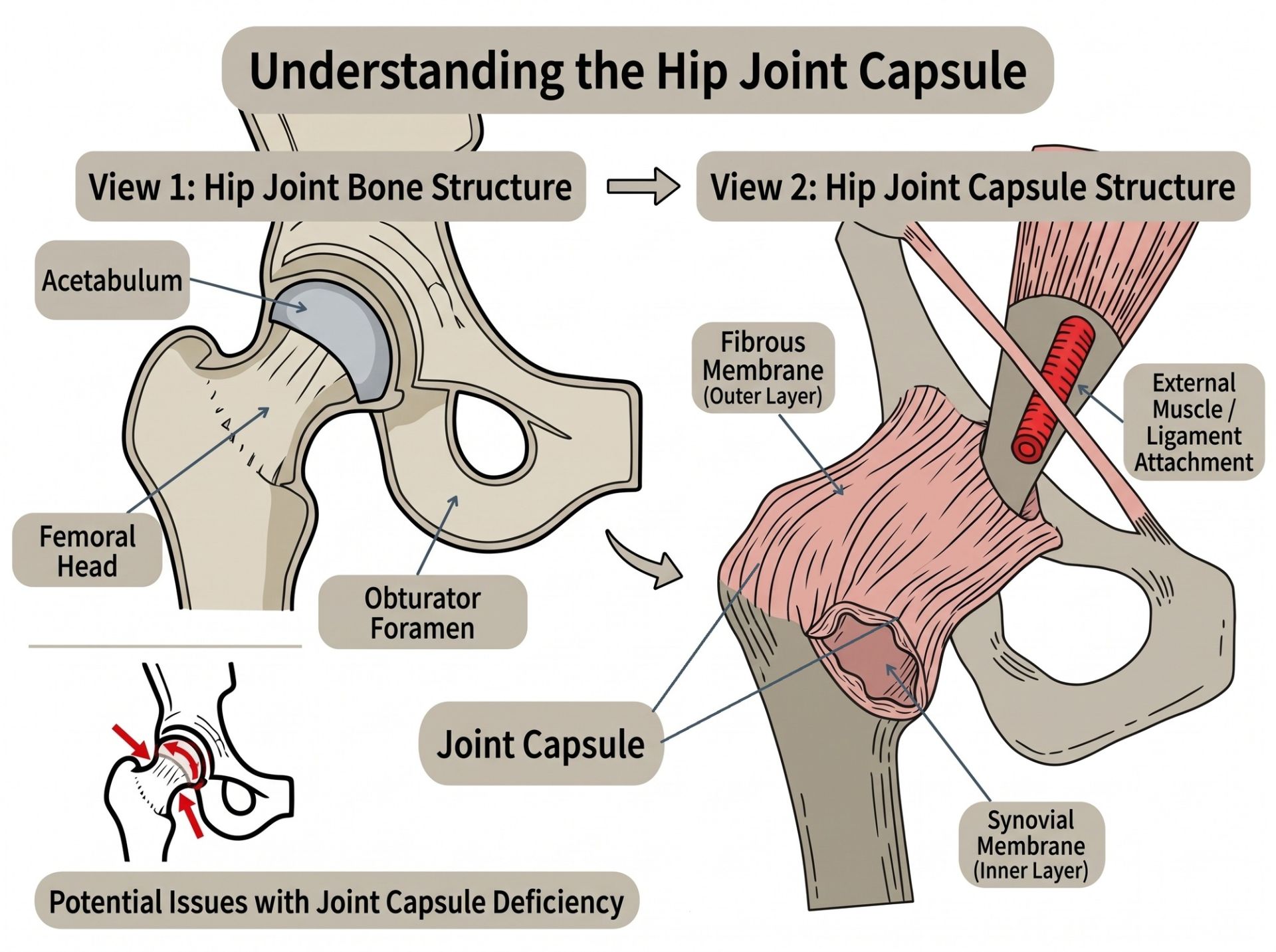
2. The Limitations of Traditional Surgery: Why Do Most Minimally Invasive Procedures Still Require Damaging the Joint Capsule?
In traditional and even standard minimally invasive surgery, surgeons typically must incise the joint capsule to obtain a better visual field for implanting the artificial joint. Although the wound heals after surgery, the original stability is sacrificed. As a result, some patients feel unsteady when walking after surgery, or even experience dislocation, requiring active rehabilitation to maintain stability.
Surgical Challenges: Performing Precise Replacement While Keeping the Joint Capsule Intact
-
Minimizing Tissue Cutting: Preserving the integrity of muscles and ligaments to the greatest extent possible.
-
High-Difficulty Spatial Maneuvering: The surgeon must have refined tactile skills to precisely complete the artificial joint replacement without damaging the joint capsule.
Why Does "Preserving the Joint Capsule" Allow You to Skip Rehabilitation and Walk Immediately After Surgery?
Preserving the joint capsule means preserving the negative pressure within the joint. Think of it like a vacuum suction cup—from the moment the artificial joint is implanted, it is as stable as the original bone. As a result, patients do not need to worry about dislocation and can get out of bed and try walking on the first day after surgery.
Immediate Restoration of Balance After Surgery
The nerve endings and proprioceptive nerves within the joint capsule are completely preserved. This means your "balance radar" remains intact. For patients, the brain's ability to sense joint position and movement is retained—there is no need for rehabilitation or relearning how to walk with an artificial joint. While traditional surgery requires months of rehabilitation to retrain balance, Dr. Chang's patients typically achieve a stable gait on the first day after surgery, achieving "no rehabilitation needed" and "early discontinuation of walking aids."
Surgical Comparison: Recovery Speed Through the Lens of Structural Preservation
【Traditional Minimally Invasive Surgery vs. Capsule-Preserving Technique】
|
Comparison Item |
Traditional Minimally Invasive Surgery |
Dr. Chien-Chun Chang's "Capsule-Preserving Technique" |
|
Muscle Damage |
Partial cutting or separation |
Significantly reduces muscle cutting |
|
Joint Capsule Management |
Must be incised |
Completely preserved, no disruption |
|
Postoperative Pain |
Moderate to high (requires substantial pain medication) |
Mild |
|
Time to Get Out of Bed |
Approximately 2–3 days |
Same day or next day after surgery |
|
Rehabilitation Needs |
Requires 3–6 months of intensive training |
Essentially no rehabilitation needed; daily walking is sufficient |
|
Dislocation Risk |
Higher (requires attention to sitting posture restrictions) |
Lower |
Dr. Chien-Chun Chang's Personal Perspective: The 3D Map in the Brain
Modern surgery often emphasizes "robotic navigation," but for an experienced team, the surgeon's "anatomical feel" is the most precise navigation of all.
Precisely because complex large-scale machinery is not required, the surgical time can be significantly shortened. This means shorter anesthesia time and less time the wound is exposed to air, which naturally leads to a significant reduction in infection risk. With a deep understanding of anatomical structures, the surgeon performs precise maneuvers within the narrow joint space—a skill that machines still cannot fully replace.
FAQFrequently Asked Questions
Q:Is formal rehabilitation really completely unnecessary?
"No rehabilitation needed" here means that patients do not need to go to a physical therapy clinic for regular scheduled training. Because the muscles and joint capsule are not damaged, "walking more" after the wound heals in the first two weeks is the best form of rehabilitation.
Q:How long is the surgical incision?
Approximately 6–8 cm, leaving only a thin line after healing.
Q:Are there any movement restrictions after surgery?
Because the joint capsule is completely preserved, both stability and flexibility are high. Patients typically do not require the strict sitting posture restrictions associated with traditional surgery. However, maintaining proper sitting posture is still recommended—avoiding excessive outward rotation or inward rotation of the legs—to maintain hip health.
This article is for educational purposes only. Please consult a qualified physician for specific medical advice.
Author & Medical Review: Chien–Chun Chang, MD, PhD
【Pioneer in Spine Endoscopic Surgery in Taiwan】
The first physician in Taiwan to demonstrate computer-assisted navigation in spine endoscopy, dedicated to improving the precision and safety of spine and joint surgery.His research, “Computer-assisted navigation in spine endoscopy,” was published in 2020 in the internationally recognized medical journal BMC Musculoskeletal Disorders (IF: 2.4), providing important evidence-based support for minimally invasive surgery.
【Minimally Invasive Joint Reconstruction Team】
Dr. Chang received specialized training in minimally invasive robotic-assisted joint replacement surgery in Japan and led his team to obtain international training certification for the ROSA robotic system. He subsequently established the International Robotic Minimally Invasive Joint Replacement Center and Training Demonstration Site.
【Areas of Expertise】
.Joint Reconstruction and Replacement: Robot-assisted minimally invasive knee replacement (ROSA Knee), minimally invasive total knee and hip replacement.
.Minimally Invasive Spine Surgery: Minimally invasive endoscopic surgery of the cervical and lumbar spine, 3D computer-navigated minimally invasive spine surgery, complex revision spine surgery and scoliosis correction, and spine fracture surgery.
.Pain Management and Regenerative Medicine: Sciatica, herniated discs, chronic low back pain, regenerative treatment for degenerative joint disease, and osteoporosis.
【Current Positions and Professional Experience】
.Taichung Municipal Elderly Rehabilitation General Hospital|Assistant Vice President & Director, Department of Orthopedics
.Ministry of Education, Taiwan|Assistant Professor
.Taiwan Society of Minimally Invasive Spine Surgery (TSMISS)|Current Board Member
.Taiwan Society of Endoscopic Spine Surgery (TSESS)|Current Board Member
.2024 National Quality Seal (SNQ)|Project Leader, A New Milestone in Spine and Joint Surgery for Older Adults: A Standardized Fast-Recovery Protocol
.2023 National Quality Seal (SNQ)|Project Leader, Standardized Protocol for Computer Navigation in Complex Spine Surgery
.Taichung Medical Association|10th Medical Contribution Award – Excellence in Professional Advancement
.ROSA Robotic System|International Robotic Training and Education Certified Instructor
.Medtronic|Director, International Computer Navigation Demonstration Center / International Lecturer in Computer-Navigated Spine Surgery
.2025 CAOS AP Faculty|International Committee Member, Asia-Pacific Computer-Assisted Orthopedic Surgery Conference
.ESPINEA|Asia-Pacific Faculty
.AO Spine Asia Pacific|Selected Fellow