

【Knee Osteoarthritis】Is Knee Replacement Always Necessary? Non-Surgical Treatment Options & Self-Help Strategies for Degenerative Knee Pain
【Article Summary 】
Knee osteoarthritis (degenerative arthritis) affects a wide age range—from young runners to elderly individuals. Drawing on nearly 20 years of clinical experience, Director Dr. Chien-Chun Chang shares an evidence-based guide to help patients with knee degeneration regain their mobility:
- Stepwise Non-Surgical Treatment: A detailed breakdown of the K-L four-stage clinical classification, comparing the therapeutic effects of hyaluronic acid, PRP, and amniotic growth factor injections.
-
New Concepts in Knee Preservation: Not all wear requires a full joint replacement. Learn how Unicompartmental Knee Arthroplasty (UKA) preserves the cruciate ligaments for appropriate candidates.
-
Precision Medicine Restoration: How the ROSA Knee robotic-arm system achieves 0.1 cm precision in bone resection, enabling 24-hour postoperative ambulation—delivering the goals of "smaller incisions, less pain, and faster recovery."

Why Do Knees "Wear Out" Early? The Causes of Osteoarthritis
To understand knee degeneration, we must first understand how the knee joint normally functions.
Daily Cartilage Wear: The Vicious Cycle of Inflammation
Knee cartilage acts like a shock absorber, cushioning the friction between bones. When cartilage is damaged, it releases inflammatory factors that trigger synovitis and joint effusion (swelling). This inflammatory response further breaks down the remaining cartilage matrix, creating a vicious cycle of "wear → inflammation → more wear." Once the cartilage is worn down to the point of bone-on-bone contact, severe pain and bone spurs (osteophytes) develop.
Risk Factors: Obesity, Old Injuries, and Improper Exercise Habits
In addition to natural aging, the following factors can accelerate the breakdown of the knee joint:
-
Obesity (High BMI)
According to research, for every 1 kg of body weight gained, the knee joint must bear an additional 4 times the pressure during walking. When climbing stairs or walking on slopes, the pressure can reach up to 7 times the body weight.
-
Unhealed Old Injuries
A history of cruciate ligament tears or meniscus injuries that have not been properly repaired can alter the joint's mechanical axis, leading to localized abnormal wear.
-
Improper Exercise Habits
Long-term participation in high-impact activities or weight-bearing exercises performed with insufficient core and lower-limb muscle strength.
-
Metabolic Diseases
Conditions such as diabetes may impair the repair capacity of synovial tissue, thereby accelerating the progression of joint degeneration.
The Four Stages of Knee Osteoarthritis: K-L Grading and Clinical Diagnosis
In clinical practice, the Kellgren-Lawrence (K-L) grading system is the most commonly used classification for assessing the severity of knee osteoarthritis.
Early Stage (Grades 1–2): How to Identify "Hidden" Signs of Degeneration?
-
Grade 1
Suspected narrowing of the joint space, with possible small bone spurs. Patients often feel mild stiffness or a "catching" sensation when standing up after sitting for a long time. Symptoms typically improve with rest.
-
Grade 2
Definite bone spur formation with mild joint space narrowing. Pain becomes more noticeable, especially during cold weather or after walking long distances. Localized tenderness over the inner side of the knee is common.
Moderate to Advanced Stage (Grades 3–4): Deformity, Bone Spurs, and Irreversible Structural Damage
-
Grade 3
Multiple bone spurs, significant joint space narrowing, and early bone hardening (sclerosis). Patients may develop a bow-legged (varus) deformity, reduced range of motion, and an inability to squat fully.
-
Grade 4
Cartilage is nearly completely worn away, with bone-on-bone contact, bone sclerosis, and possible bone cysts. Walking becomes extremely difficult. Even short distances cause severe pain, significantly compromising quality of life and mobility.
Diagnostic Tools: When to Use X-ray, MRI, and Arthroscopy
-
Weight-Bearing X-ray
This is the standard for diagnosing knee osteoarthritis. It must be taken while standing and bearing weight to accurately reflect the degree of joint space narrowing.
-
Magnetic Resonance Imaging (MRI)
Used to diagnose early cartilage damage or meniscal tears, primarily for patients whose X-rays show no obvious abnormality but whose symptoms persist without improvement.
-
Arthroscopy
Through a small minimally invasive incision, a high-magnification endoscope is inserted directly into the joint cavity to visually assess the actual condition of soft tissues, including cartilage, meniscus, and synovium. It is the most intuitive diagnostic tool for evaluating intra-articular pathology.
Stepwise "Non-Surgical" Treatment: Extending the Life of Your Natural Joint
The core principle of modern medicine is "stepwise treatment." Before considering surgery, we first try conservative therapies with the goal of "relieving pain, improving function, and delaying surgery."
1. Lifestyle Modification and Weight Loss: Reducing Knee Joint Load
Studies show that losing approximately 5-10% of body weight can significantly reduce inflammatory markers. It is also recommended to adjust daily habits—such as reducing bending, avoiding carrying heavy loads while climbing stairs—to protect knee cartilage in everyday life.
2. Physical Therapy and Exercise Prescription: Quadriceps and Core Strengthening
Strong quadriceps act like a natural knee brace, absorbing impact forces. Closed-chain exercises (such as wall squats and straight leg raises) can effectively share joint load. In addition, physical therapy that improves joint range of motion helps prevent joint capsule contracture.
3. Injection Therapies: A Comparison of Hyaluronic Acid, PRP, and Amniotic Growth Factor
-
Hyaluronic Acid
Acts like adding lubricant to the joint. Its molecular weight determines its lubrication and anti-inflammatory effects. Suitable for mild to moderate degeneration (Grades 1–2).
-
Platelet-Rich Plasma (PRP)
Extracted from the patient's own blood. Its high concentration of growth factors helps induce tissue repair and reduce local inflammation.
-
Amniotic Growth Factor / Stem Cells
A more advanced biologic therapy. Rich in multiple repair proteins, it offers another biological restoration option for patients who wish to delay surgery
Precision "Surgical" Treatment: Should I Choose "Partial Knee" or "Total Knee"?
When conservative treatment can no longer maintain quality of life—for example, being unable to walk more than 15 minutes or waking up from pain during sleep—surgery becomes the turning point for restoring mobility.
Knee Replacement Surgery
The traditional concept often assumes "replace it when it's worn out." However, modern orthopedics offers "joint preservation" options. Surgery can be performed to repair only the damaged areas, preserving the remaining healthy bone, ligaments, and nerve proprioceptors. This allows the joint to function more closely to a natural knee after surgery.
"Partial Knee" Replacement (UKA): Minimally Invasive, Fast Recovery, Ligament Preservation
If the wear is limited to the medial compartment and the cruciate ligaments are intact, partial knee replacement offers the following benefits:
-
More refined incision: Reduced disruption to the quadriceps muscle.
-
More natural range of motion:Because the cruciate ligaments are preserved, patients experience better balance and stability when climbing stairs compared to total knee replacement.
-
Shorter recovery time: Most patients can get out of bed with a walker the day after surgery, with a lighter rehabilitation burden.
▸Related article: The Complete Guide to Minimally Invasive Unicompartmental Knee Arthroplasty (UKA): Precision Treatment and Rapid Recovery – Say Goodbye to Knee Degeneration Pain
"Total Knee" Replacement (TKR): The Definitive Solution for Extensive Wear and Severe Deformity
When both the medial and lateral compartments are damaged, or when there is significant bone deformity, total knee replacement is required. This is a well-established procedure with a high success rate, capable of completely resolving the mechanical pain caused by severe joint wear.
Technology-Assisted Surgery: ROSA Knee Robotic-Arm System and Precision Medicine
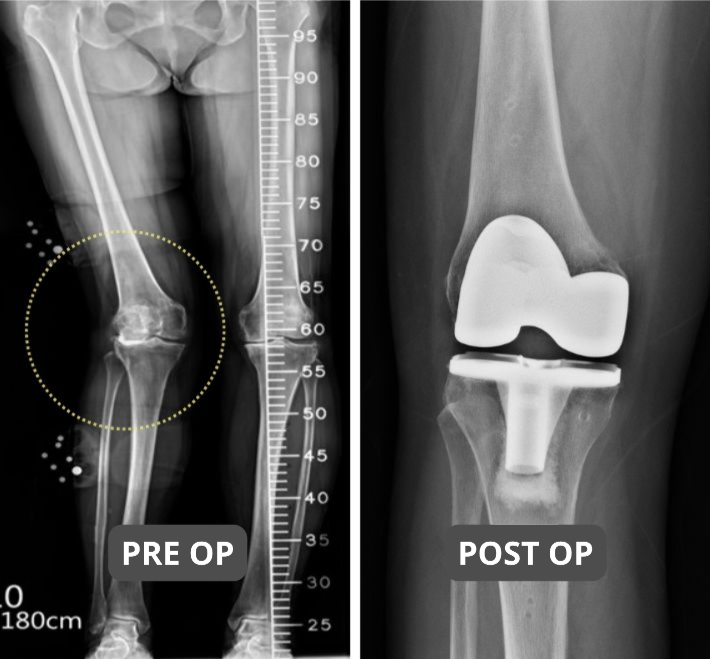
In our clinical experience, precision is the core of successful knee replacement surgery. To achieve this, we have introduced the ROSA Knee robotic-arm assisted system, which further enhances the accuracy and safety of the procedure.[1]
🔸 Preoperative Precision Planning: Based on the patient's preoperative X-ray images, a personalized 3D knee model is created to pre-plan the optimal implant size, placement angle, and bone resection positions.
🔸 Intraoperative Real-Time Feedback: During surgery, the ROSA system continuously monitors soft tissue tension and range of motion at multiple angles, providing dynamic data to assist the surgeon in performing fine-tuned soft tissue balance adjustments.
🔸Precision Bone Resection: With robotic-arm assistance, bone cutting errors can be controlled to within 0.1 cm, ensuring a perfect fit between the implant and the bone, and reconstructing a near-natural mechanical axis for the knee joint.
🔸Minimally Invasive, Less Pain, Faster Recovery: Because of this precision, we can maximize the preservation of healthy bone and soft tissue, reducing surgical trauma. This is exactly why many of our patients are able to walk within 24 hours after surgery and return to their daily lives quickly.
Postoperative Rehabilitation and Long-Term Maintenance Guide
Surgical success accounts for only 50% of the outcome. The other 50% depends on rehabilitation. In Dr. Chien-Chun Chang's team, we emphasize the concept of "immediate postoperative rehabilitation" to prevent joint stiffness.
Golden Rehabilitation Period Plan: Progress Timeline from Day 1 to 3 Months
-
Days 1–3 (Bed Rest and Initial Ambulation)
The goals are to reduce swelling and promote lower limb circulation. A CPM (Continuous Passive Motion) machine is used to assist joint movement, and patients are encouraged to try standing or walking short distances with a walker.
-
Weeks 1–4 (Range of Motion and Basic Strength)
The focus is on achieving full knee extension and flexion (target: 120 degrees). Straight leg raises are performed to strengthen the quadriceps.
-
Months 1–3 (Functional Reconstruction Phase)
Patients gradually wean off the walker and begin balance training and stair climbing. Stationary cycling may be introduced during this phase.
Postoperative Exercise Recommendations and Precautions: How to Make Your New Joint Last Over 20 Years?
-
Recommended Activities: Swimming, brisk walking, stationary cycling, golf.
-
Activities to Avoid: High-impact activities such as long-distance running, frequent deep squats or kneeling, and sports that involve intense twisting of the knee such as badminton or basketball (unless postoperative recovery is optimal and cleared by a physician).
In-Depth Comparison: Medical Decision-Making Table
To help you, your family, or friends make an initial assessment, I have summarized the common clinical treatment options and corresponding grades as follows:
Knee Osteoarthritis Grade and Corresponding Treatment Recommendation Table
|
Degeneration Grade |
Clinical Features |
Recommended Treatment |
Goal |
|
Grade 1 (Early) |
Suspected joint space narrowing, minor bone spurs |
Lifestyle modification, muscle strengthening, physical therapy |
Slow down degeneration |
|
Grade 2 (Mild) |
Definite bone spurs, joint soreness |
Weight management, hyaluronic acid injections, oral joint protective supplements |
Relieve pain, lubricate the joint |
|
Grade 3 (Moderate) |
Multiple bone spurs, marked joint space narrowing |
PRP injections, amniotic growth factor therapy, knee preservation surgery (HTO/UKA) |
Repair tissue, correct alignment |
|
Grade 4 (Severe) |
Cartilage nearly worn away, bone-on-bone friction |
Total knee replacement (TKR) |
Restore function, eliminate pain |
Injection Therapy Comparison: Hyaluronic Acid vs. PRP vs. Amniotic Growth Factor
|
Comparison Item |
Hyaluronic Acid (HA) |
PRP (Platelet-Rich Plasma) |
Amniotic Growth Factor / Stem Cells |
|
Mechanism of Action |
Mechanical lubrication, anti-inflammatory effects |
Releases growth factors, induces tissue repair |
Provides abundant repair proteins, potent anti-inflammatory effects |
|
Suitable Candidates |
Mild degeneration, patients seeking high cost-effectiveness |
Moderate degeneration, patients hoping to promote tissue repair |
Severe degeneration but unwilling to undergo surgery, patients with higher budget |
|
Duration of Effect |
Approximately 6 months to 1 year |
Varies depending on repair response, typically about 1 year |
Longer duration, with superior biological repair potential |
Key Decision: Partial Knee Replacement (UKA) vs. Total Knee Replacement (TKR) – A Comprehensive Comparison
|
Comparison Item |
Unicompartmental Knee Arthroplasty (Partial Knee UKA) |
Total Knee Replacement (Total Knee TKR) |
|
Surgical Scope |
Replaces only the damaged medial (or lateral) compartment |
Replaces the entire joint surface |
|
Ligament Preservation |
Preserves both anterior and posterior cruciate ligaments |
Cruciate ligaments are usually removed (depending on implant design) |
|
Postoperative Sensation |
Feels very close to a natural knee, excellent proprioception |
High stability, but may feel somewhat mechanical during movement |
|
Incision and Recovery |
Smaller incision (approx. 6–8 cm), very fast recovery |
Larger incision, longer rehabilitation period |
|
Indications |
Localized wear, intact cruciate ligament function |
Extensive wear, severe bow-legged (varus) deformity or bone deformity |
Conclusion: Multidisciplinary Integrated Care to Restore Mobility
Knee degeneration itself is not frightening. What is truly concerning is the prolonged suffering caused by fear of surgery, leading to muscle atrophy and a diminished quality of life.
From preventive medicine through muscle strengthening, to precision medicine with biological injections, and finally to cutting-edge technology with robotic-assisted surgery, modern orthopedics offers a complete stepwise solution. My medical philosophy is: "We don't perform surgery just to replace a joint—we treat to help you regain the dignity and freedom to walk." Through precise diagnosis and personalized treatment plans, we can work together to protect your knee joint for the long term.
Knee Osteoarthritis Treatment FAQ
Q:Is hyaluronic acid injection necessary for knee pain?
Hyaluronic acid is not the only option. It primarily acts as a "joint lubricant" to reduce friction-related pain. If your knee pain is caused by muscle imbalance or ligament injury, hyaluronic acid injections alone may have limited effectiveness. It is recommended to first undergo an X-ray evaluation to determine the grade of degeneration. For mild cases, hyaluronic acid may be considered; for moderate to severe cases, PRP injections or knee replacement surgery should be considered.
【Key Evidence】
According to a 2024 meta-analysis published in Pharmaceuticals, hyaluronic acid injections were shown to significantly reduce knee pain within 2 to 8 weeks, but had limited effectiveness in improving joint function. Another large-scale meta-analysis from 2025 indicated that hyaluronic acid is most suitable for patients with early-stage degeneration (K-L Grades 1–2).[2]
Q:How many PRP injections are needed to see results?
While a single injection may provide relief for early discomfort, a complete course of 3 PRP injections is recommended to achieve long-term and stable repair effects.
【Key Evidence】
According to a 2025 meta-analysis published in the European Journal of Medical Research, the optimal PRP injection protocol consists of 3 to 5 injections administered at 7- to 14-day intervals, with the best outcomes observed in patients with early-stage degeneration (K-L Grades 1–2).[3][4]
Q:Are glucosamine and UC-II really effective for knee health?
These are classified as "dietary supplements." UC-II (Type II collagen) has been shown in some studies to provide auxiliary benefits in relieving joint discomfort. However, it is important to understand that supplements cannot regenerate worn cartilage. Their role is "maintenance" rather than "treatment." When degeneration progresses to Grade 3 or above, the effectiveness of supplements is usually minimal.
【Key Evidence】
Although glucosamine and UC-II are commonly used, according to the latest high-quality meta-analyses, they are not the most effective options available. Certain specific ingredients (such as Aflapin and NEM) may offer better results, but these are less commonly found in Taiwan.[5]
Q:Can I still run if I have knee osteoarthritis?
It depends on the grade. For patients with early-stage degeneration, moderate jogging can be beneficial for muscle strengthening, provided that adequate warm-up and proper running shoes are used. However, if the degeneration has progressed to moderate or advanced stages, high-impact running may accelerate cartilage wear. I recommend switching to water running, brisk walking, or stationary cycling—these activities help maintain cardiovascular fitness while protecting the joint.
【Key Evidence】
Studies have shown that running does temporarily thin the cartilage after exercise, but like a sponge being compressed, it returns to its original state after rest. For healthy or mildly degenerated knees, moderate running does not cause permanent damage.[6]
Q:How long does an artificial knee joint last?
With modern materials science and precision surgical techniques, the lifespan of artificial joints has been significantly extended.
【Key Evidence】
According to a 2019 study published in The Lancet—one of the world's leading medical journals—as many as 90% of total knee replacements (TKR) remain functional 20 years after implantation, and over 82% continue to perform well for 25 years or more.[7]
Q:Is robotic-assisted knee replacement surgery really better than traditional surgery?
Robotic-assisted surgery does not replace the surgeon—it provides precision navigation and real-time data feedback. It can control bone resection errors to within 0.1 cm and dynamically monitor ligament tension during surgery, enabling more personalized joint balancing. For patients seeking faster recovery and long-term joint function, it does offer clinical advantages.
【Key Evidence】
According to a 2025 meta-analysis published in the Journal of Experimental Orthopaedics, robotic-assisted total knee replacement demonstrated significantly superior radiographic accuracy compared to traditional surgery, with a 10–24% reduction in outliers.[8]
Q:How can I prevent joint stiffness and fibrosis after surgery?
The key lies in "early mobilization." Joint movement can begin on the first day after surgery within a tolerable pain range. In addition, it is important to consistently perform the stretching exercises recommended by the physical therapist, combined with professional swelling management (ice therapy and compression).
【Key Evidence】
According to a 2024 study published in BMC Musculoskeletal Disorders, "active mobilization" is more important than passive waiting after surgery. Active resistance exercises significantly improve joint range of motion, reduce pain, and enhance muscle strength.[9]
This article is for educational purposes only. Please consult a qualified physician for specific medical advice.
【References】
1. Robot-Assisted versus Conventional Total and Unicompartmental Knee Arthroplasty: A Meta-analysis of Radiological and Functional Outcomes. J Knee Surg. 2025 Jan;38(1):12-25. doi: 10.1055/a-2493-7229. Epub 2024 Dec 16. PMID: 39681234.
【Key Evidence】 According to a 2025 meta-analysis published in The Journal of Knee Surgery (covering 30 studies), robotic-assisted surgery significantly improves radiographic accuracy and reduces outlier rates in both total and unicompartmental knee arthroplasty. In terms of functional recovery, robotic-assisted unicompartmental knee arthroplasty (RA-UKA) demonstrated faster recovery and higher patient satisfaction compared to total knee replacement—provided that the wear is limited to a single compartment and the cruciate ligaments are intact. This study clearly indicates that there is no absolute superiority between "partial knee" and "total knee"; the key lies in "choosing the procedure that best fits the patient's condition."
2. Migliorini F, Maffulli N, Simeone F, et al. Intra-articular hyaluronic acid injections may be beneficial in patients with less advanced knee osteoarthritis: a systematic review of randomised controlled trials. Sports Med Open. 2025;55:1953-1969. doi: 10.1007/s40279-025-02265-8.
【Key Evidence】 According to a 2024 meta-analysis published in Pharmaceuticals (3,851 patients), hyaluronic acid injections significantly reduce knee pain within 2 to 8 weeks, but have limited effectiveness in improving function. Another large-scale 2025 meta-analysis (71 RCTs, 10,590 patients) further indicated that hyaluronic acid is most suitable for patients with early-stage degeneration (K-L Grades 1–2), particularly older women, who may experience better long-term improvement.
3. Kamada K, Matsushita T, Yamashita T, et al. Factors affecting the therapeutic effects of multiple intra-articular injections of platelet-rich-plasma for knee osteoarthritis. Asia Pac J Sports Med Arthrosc Rehabil Technol. 2024 Sep 30;38:43-48. doi: 10.1016/j.asmart.2024.09.006.
【Key Evidence】A 2024 large-scale study (701 patients) demonstrated that the number of PRP injections should be personalized based on the degree of degeneration: 3 injections are recommended for early-stage degeneration (K-L Grades 1–2), while more than 3 injections are required for advanced degeneration (K-L Grade 4) to achieve optimal results. Age and baseline pain level are also key factors affecting treatment efficacy.
4. McLarnon M, Heron N. Intra-articular platelet-rich plasma injections versus intra-articular corticosteroid injections for symptomatic management of knee osteoarthritis: systematic review and meta-analysis. BMC Musculoskelet Disord. 2021 Jun 16;22(1):550. doi: 10.1186/s12891-021-04308-3. PMID: 34134679; PMCID: PMC8208610.
【Key Evidence】According to a 2021 systematic review and meta-analysis published in BMC Musculoskeletal Disorders (8 studies, 648 patients), three PRP injections (at weekly intervals) were significantly more effective than a single injection at 12‑month follow‑up (P < 0.01), and PRP was superior to corticosteroid injections in improving pain, stiffness, and function.
5. Du P, Ajia A, Xiang Z, Zheng S, Hu C, Wang P. Efficacy of dietary supplements for treating knee osteoarthritis: a systematic review and network meta-analysis. Front Nutr. 2025 Mar 6;12:1556133. doi: 10.3389/fnut.2025.1556133. PMID: 40123938; PMCID: PMC11964734.
【Key Evidence】Although glucosamine and UC-II are commonly used, according to the latest high-quality network meta-analysis, they are not the most effective options. Certain specific ingredients (such as Aflapin and NEM) may offer better results, but these are less commonly found in Taiwan. Therefore, positioning them as "supplements" rather than "therapeutic agents" is appropriate.
6. Coburn SL, Crossley KM, Kemp JL, Warden SJ, West TJ, Bruder AM, Mentiplay BF, Culvenor AG. Is running good or bad for your knees? A systematic review and meta-analysis of cartilage morphology and composition changes in the tibiofemoral and patellofemoral joints. Osteoarthritis Cartilage. 2023 Feb;31(2):144-157. doi: 10.1016/j.joca.2022.09.013. PMID: 36334753.
【Key Evidence】The literature review indicates that running does temporarily thin cartilage after exercise, but like a sponge being compressed, it returns to its original state after rest. For healthy or mildly degenerated knees, moderate running does not cause permanent damage.
7. How long does a knee replacement last? A systematic review and meta-analysis of case series and national registry reports with more than 15 years of follow-up. The Lancet. 2019.
【Key Evidence】 According to a large-scale systematic review published in 2019 in The Lancet—one of the world's leading medical journals—as many as 90% of total knee replacements (TKR) remain functional 20 years after implantation, and over 82% continue to perform well for 25 years or more. This evidence strongly demonstrates that modern artificial joints can reliably help patients regain mobility, significantly alleviating concerns about revision surgery among middle-aged and elderly patients.
8. Sacco R, Tecame A, Lalevée M, Perrier A, Massa E, Kouyoumdjian P, Adravanti P. Robotic vs. conventional total knee arthroplasty over two decades: Evolving trends toward personalised alignment without significant clinical superiority in predominantly mild varus deformity-A systematic review of RCTs. J Exp Orthop. 2025 Dec 2;12(4):e70452. doi: 10.1002/jeo2.70452. PMID: 41341124; PMCID: PMC12670295.
【Key Evidence】 According to a 2025 meta-analysis published in the Journal of Experimental Orthopaedics (9 RCTs, 627 knees), robotic-assisted total knee replacement demonstrated significantly superior radiographic accuracy compared to conventional surgery (10–24% reduction in outliers). Although no statistically significant differences were found in functional outcome scores (WOMAC, OKS, KSS), the study reflects the objective advantages of minimally invasive techniques in terms of improved accuracy, reduced complications, and shortened hospital stays.
9. Wei G, Shang Z, Li Y, Wu Y, Zhang L. Effects of lower-limb active resistance exercise on mobility, physical function, knee strength and pain intensity in patients with total knee arthroplasty: a systematic review and meta-analysis. BMC Musculoskelet Disord. 2024 Sep 12;25(1):735. doi: 10.1186/s12891-024-07845-9. PMID: 39267067; PMCID: PMC11396764.
【Key Evidence】 According to a 2024 study published in BMC Musculoskeletal Disorders, postoperative "active mobilization" is more important than passive waiting. Active resistance exercises significantly improve joint range of motion, reduce pain, and enhance muscle strength—providing the scientific basis for "early mobilization."
Author & Medical Review: Chien–Chun Chang, MD, PhD
【Taiwan's Pioneer in Computer-Navigated Spine Endoscopy】
Dr. Chang is the first surgeon in Taiwan to demonstrate computer-assisted navigated spinal endoscopic surgery, advancing the precision and safety of minimally invasive spine surgery.His research, "Computer-assisted Navigation in Spine Endoscopy," was published in BMC Musculoskeletal Disorders (2020, Impact Factor 2.4), providing important clinical evidence supporting computer-assisted minimally invasive spine surgery.
【Areas of Expertise】
Minimally Invasive Spine Surgery
- Cervical and lumbar endoscopic spine surgery
- 3D computer-assspine surgery
- Complex revision spine surgery
- Scoliosis correction
- Spine fracture surgery
Navigation Surgery
- Robot-assisted knee replacement (ROSA Knee)
- Minimally invasive total knee replacement
- Minimally invasive total hip replacement
Pain Management & Regenerative Medicine
- Sciatica
- Herniated disc
- Chronic low back pain
- Regenerative treatment for osteoarthritis
- Osteoporosis management
【Professional Appointments】
- Assistant Superintendent & Chief of Orthopedic Surgery
Taichung Municipal Senior Rehabilitation General Hospital - Ministry of Education Certified Assistant Professor
- Board Member (13th Term)
Taiwan Society of Minimally Invasive Spine Surgery (TSMISS) - Board Member (5th Term)
Taiwan Society of Endoscopic Spine Surgery (TSESS)